Category: Blog Tour (Page 3 of 9)

Machine Journey by Richard Doyle

Welcome to Halfman, Halfbook for my stop on the Blog Tour for Machine Journey by Richard Doyle.

About the Book

Machine Journey is a pamphlet of poems and flash fictions. Travel the road from Slough to Mars. Discover wild visions, strange tales and machine futures. Scramble your way to the prefect stroke


About the Author

Author Photo

Richard Doyle is an old-school SF fan who began writing seriously in 2001. He has a Diploma in Creative Writing from the University of East Anglia and collaborated on a book in 2006. He has had poems published in the UK poetry magazines Orbis and Sarasvati and is a regular member of the Bristol Stanza Poetry Group. His debut pamphlet “The death of the sentence” was published in 2020. Two of his poems appear in the Bristol Stanza pamphlet “The Weather Indoors” (2021).


My Review

This is a strange and eclectic collection of verse and prose. There are poems about being a writer and how he shuffles scenes of death and dramatic entrances. It is the first collection that I have read that had something about Slough of all places.

He moves from the Stone Age with the poem called the Stone Computer about the screen that has not displayed an image for hundreds of years to the far future and a trip to Mars.

I particularly liked the Collision With A Greenberg, kind of a green punk story about an event that took place and Encounter with an Angel where someone has an angel reach out to touch them and The Trouble With Spaceships and novel and possibly illegal ways of travelling to Mars.

I liked this short collection. Doyle has drawn on subjects that are niche and wide-ranging. They are quirky and infused with gentle humour and are a pleasure to read.


Don’t forget to visit the other blogs on the blog tour

Buy this at your local independent bookshop. If you’re not sure where your nearest is then you can find one here

My thanks to Isabelle Keynon for the copy of the book to read.

Fledgling by Hannah Bourne-Taylor

Welcome to Halfman, Halfbook for my stop on the Blog Tour for Fledgling by Hannah Bourne-Taylor and published by Arum Books.

About the Book

Read the powerful account of one woman’s struggle to reshape her identity when all normality has fallen away.

When lifelong bird-lover Hannah Bourne-Taylor moved with her husband to Ghana seven years ago she couldn’t have anticipated how her life would be forever changed by her unexpected encounters with nature and the subsequent bonds she formed.

Plucked from the comfort and predictability of her life before, Hannah struggled to establish herself in her new environment, striving to belong in the rural grasslands far away from home.

In this challenging situation, she was forced to turn inwards and interrogate her own sense of identity, however in the animal life around her, and in two wild birds in particular, Hannah found a source of solace and a way to reconnect with the world in which she was living.

Fledgling is a portrayal of adaptability, resilience and self-discovery in the face of isolation and change, fuelled by the quiet power of nature and the unexpected bonds with animals she encounters.

Hannah encourages us to reconsider the conventional boundaries of the relationships people have with animals through her inspiring and very beautiful glimpse of what is possible when we allow ourselves to connect to the natural world.

Full of determination and compassion, Fledgling is a powerful meditation on our instinctive connection to nature. It shows that even the tiniest of birds can teach us what is important in life and how to embrace every day.

About the Author

Hannah Bourne-Taylor graduated from the London College of Fashion, with a First in Photography in 2008. She became an equine photographer with photographs exhibited in the Royal Academy and solo exhibitions in London and New York. From 2013 – 2021 Hannah lived in rural Ghana with her husband who ran the ‘Right to Dream’ charitable foundation. She worked within the charity’s media team producing a documentary series on gender equality in celebration of the foundation’s girls’ programme, the first of its kind in Africa. Since 2019, Hannah has ghost written and edited several books, including working closely with Anne Glenconner on her bestselling Lady in Waiting: My Extraordinary Life in the Shadow of the Crown.

My Review

Almost four thousand miles from her home in southern England lies the house that she lived in, in Ghana. It is located very close to the 0-degree latitude and longitude intersection and is so utterly different to anything else that she was used to. She was with her husband who was running a sports foundation. He has all the various permits needed to work there, but being a trailing spouse, someone who was not allowed any paid work in the country.

Her residence permit was vividly marked ‘dependent’.  To say that she was lonely and lost was an understatement. She clung to little treats, such as a spoonful of marmalade each day as a reminder of home and happier times. It was supposed to be an adventure, but the warning from her parents about what could go wrong and the snakes that could kill her should she happen to come across them was just terrifying.

One thing that did lift her was the return of the swift from their long journey back from Europe. She stood out in a rainstorm waiting for them to arrive and soon after the rain stopped they appeared in the sky screaming and acting like aeronautical hooligans as they flew far too close to everything. As the sun set, she turned for home and as she approached the school, she saw a man poking under the eaves, she saw something fall and after he had left went over to see. There was a tiny swift in amongst the debris. She tried to help it, but it didn’t want to leave her hand. She made a snap decision and took it, home.

I didn’t fully realise it at the time, but it was not just the bird’s life at stake. Somehow, it was also mine.

This was the moment that it changed for her in Ghana, this new beginning with this swift gave her a purpose and the goal of getting this bird back into the air with its fellows. It would not be the first bird, she would end up caring for a mannikin finch after. It is a heartfelt memoir about one woman’s loneliness in another country and the way that she manages to cope with being far from home and family. Bourne-Taylor is very open and honest about her feelings all the way through the book and I think that she writes well in this, her debut. We all take different things from immersion in the natural world and this is how it gave as much to her as she gave back to it.

Don’t forget to visit the other blogs on the blog tour

Buy this at your local independent bookshop. If you’re not sure where your nearest is then you can find one here

My thanks to Anne Cater of Random Things for arranging a copy of the book to read

Hannah can be found here; or on Twitter, here

The publisher is here


London Clay by Tom Chivers

Welcome to Halfman, Halfbook for my stop on the Blog Tour for London Clay by Tom Chivers and published by Doubleday .


About the Book

Part personal memoir, part lyrical meditation, London Clay takes us deep in to the nooks and crannies of a forgotten city: a hidden landscape long buried underneath the sprawling metropolis. Armed with just his tattered Streetfinder map, author Tom Chivers follows concealed pathways and explores lost islands, to uncover the geological mysteries that burst up through the pavement and bubble to the surface of our streets.

From Roman ruins to a submerged playhouse, abandoned Tube stations to ancient riverbeds, marshes and woodlands, this network of journeys combines to produce a compelling interrogation of London’s past. London Clay examines landscape and our connection to place, and celebrates urban edgelands: in-between spaces where the natural world and the city mingle, and where ghosts of the deep past can be felt as a buzzing in the skull. It is also a personal account of growing up in London, and of overcoming loss through the layered stories of the capital.

Written in rich and vivid prose, London Clay will inspire readers to think about what lies beneath their feet, and by doing so reveal new ways of looking at the city.


About the Author

TOM CHIVERS is a poet and publisher. He is the author of two pamphlets and two full collections of poetry to date, and is director of the independent press Penned in the Margins. In 2008 he was the Bishopsgate Institute’s first writer in residence, and has appeared widely at events and made a number of contributions to radio, including presenting a 30 minute documentary for Radio 4. He has collaborated with the climate arts organisation Cape Farewell and conducts immersive walking tours of London. Chivers is currently an Associate Artist of the National Centre for Writing.


My Review

London has a long history, for the past 2000 thousand years, it has grown to the financial and cultural global city of today whilst surviving several invasions, one major fire, a plague or two. Bronze Age bridges have been found but the people that made it their own were the Romans. They settled there and made their city at the point where it was possible to cross. The river meant they could control the local area and still have access to the resources and might of their empire.

But Chivers wants to start with the real history of the place, seeking the deep history of the landscapes of the lost rivers and secret woodlands. Like with all good adventures it begins with a map, a streetfinder that is being changed with felt tip pens and highlighters. Trafalgar  Square turns orange to show the underlying silt and clay, the banks of the Thames are shade yellow to represent the alluvium deposited by the river. Under all of these layers is the clay that has played a big part in the creation of the city as some of the people who have inhabited it. As the maps are coloured in, features that have long been hidden show their ghostly presence once again.

A map is only so useful though. What he needs to do it to start to see if that underlying geology is still visible in the modern concrete jungle. He knows exactly where to start too, Aldgate. It was here that he noticed a trench that was around 15 feet deep and was slowly accumulating junk. He could see the brick lining but also visible was the silt that built London. But it is a reminder that London is a city that is constantly changing, buildings that are not that old are ripped out to make space for the newest glass edifices. His next journey takes him to Dulwich in search of the rivers that once flowed across the city and now only flow through culverts before he traces the Walbrook on the modern streets.

It is clay. Of course it is. London Clay. I cannot help myself. I stretch my hand towards the bank and dig my thumb in. it comes out thick and yellow. The dark, sandy yellow of London stock brick. Clay.

Westminster is now the centre of our government and establishment, but it used to be a river delta in its past. He heads down into a sewer to see the River Fleet and has to shower a long time after that experience. If you know where and how to look there are still echoes of the roads that the Romans first used, Watling Street, Stane Street as well as hints of more recent London, as he searches for the lost island of Bermondsey and sees if the Olympic Park has eradicated the ancient causeway that crossed the marshes.

I thought this was a fantastic book. For me, Chivers has got the mix of history, geology and personal memoir spot on. I particularly liked the way that he sees the way that even the modern cityscape reflects the underlying geology, the subtle rises in the modern tarmac reveal the paths of ancient causeways and the traces of the rivers long since buried under the streets. He has a way of bringing to the surface, moments of London’s ancient history in a way that is utterly compelling. He draws deeply from his life as a Londoner and his knack of seeing the tiniest detail in the cityscape he walks is transferred onto the page as he uses his skill as a poet in the wonderful prose. If you want a very different book on London that explores how we have transformed the city as much as it has shaped our nation.


Don’t forget to visit the other blogs on the blog tour:


Buy this at your local independent bookshop. If you’re not sure where your nearest is then you can find one here

My thanks to Anne Cater of Random Things Tours and Doubleday for the copy of the book to read.

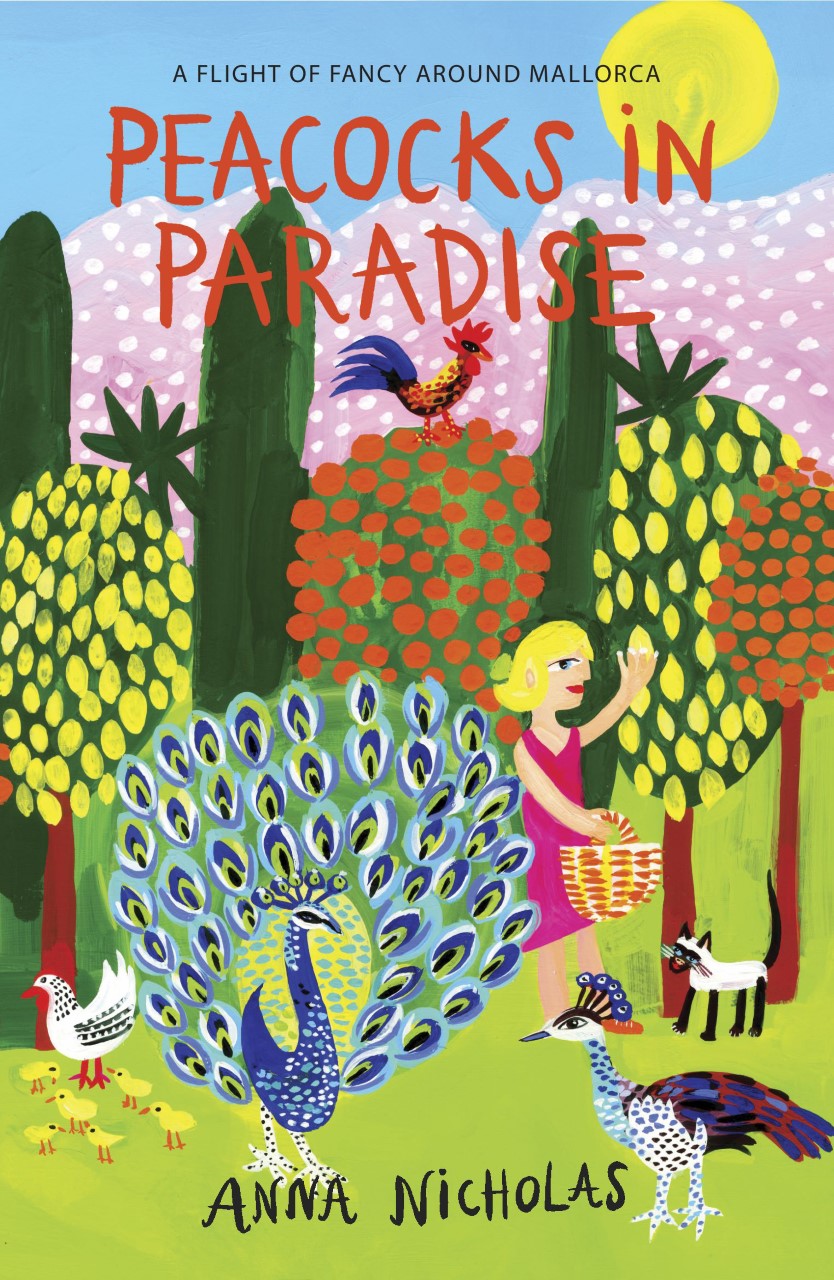
Peacocks in Paradise by Anna Nicholas

Welcome to Halfman, Halfbook for my stop on the Blog Tour for Peacocks in Paradise by Anna Nicholas and published by Burro Books.


About the Book

The long-awaited seventh title in Anna Nicholas’s humorous travel series about how to live the dream in a Mediterranean country. The author explores different local cultural themes in each title. Anna delves into the island’s authentic heartland, exploring nature reserves, bird sanctuaries and paprika, fruit and almond farms. On her travels, she meets the makers of siurell whistles, palm leaf baskets, hot sauces and ensaimada pastries, and revels in visiting local producers of wine, craft beer, gin and brandy – and Mallorca’s famed herbes liqueur. Meanwhile, she and chum, Alison, are tackling all 54 Tramuntana peaks over 1,000m, enduring the arduous overnight Guell hike to Lluc Monastery along the way.


About the Author

Anna Nicholas is of Celtic origin & has lived for 18 years in rural Mallorca. An inveterate traveller & experienced freelance journalist, she regularly participates in humanitarian aid expeditions overseas with British explorer Colonel John Blashford-Snell, CBE and is a Fellow of the RGS. She ran her own PR company in Mayfair, London, for 20 years, was a Guinness Book of Records adjudicator alongside the book’s founder, Norris McWhirter, CBE, and as a rookie press officer at charity Help the Aged, handled events for Princess Diana. She runs an international marathon annually for her favourite causes.


My Review

There are nicer ways to be woken than a hearing the screeching of a peacock, but the most recent addition to their ever-growing menagerie has a habit of waking them at some ungodly hour before the alarm goes off. She glances out of the window and sees the sun lighting the Tramuntana mountains. One very strong cup of coffee later and they are ready to face the day.

The peacock is just one of the numerous animals that they have around their home. Over the course of the book, they seem to end up with an endless influx of other animals as well as finding a large number of kittens on their property. They have a full and entertaining life there in Mallorca, her son has left home now and is in other parts of Europe, they miss him, but he is travelling as she did at the same age.

They are fully embedded in life on the island and you sense from the scenes she describes with the neighbours that they have got deep and long-lasting friendships with neighbours and others around the islands. They are partial to good food and wine, and they are always travelling around in their battered mini to all sorts of different places to meet various food and wine producers of the island. They are often out to lunch with friends or visiting organisations that are trying to help local species and protect the local environment. There is a little part of the story in London too. In her past life, Nicholas was a PR and old friends want to use her skills to help launch a new set of products in Mallorca. Whilst in London it gives her time to catch up with some old friends that she wouldn’t normally see.

I really enjoyed this. It is a welcome break from the gloom of the pandemic that keeps rumbling on. Nicholas writes in a chatty style as she tells us about her extremely busy life in Mallorca. She is really good at extracting the details from the things that she is doing, whether that is the walking challenge that she undertakes with her friend up the fifty-four peaks over 1000m or the time spent at a number of vineyards or just the interactions with her friends and neighbours on a daily basis. She is a good saleswoman too because having read about the island I now want to visit it and see it for myself. Even though this is the seventh book in the series, this is the first of the series that I have read. I do have one of the others and as I really enjoyed this I am going to make an effort to get and read the others.


Don’t forget to visit the other blogs on the blog tour


Buy this at your local independent bookshop. If you’re not sure where your nearest is then you can find one here


My thanks to Anne Cater of Random Tours and  Anna Nicholas for providing a copy of the book to read.

The Storm Is Upon Us by Mike Rothschild

Welcome to Halfman, Halfbook for my stop on the Blog Tour for The Storm Is Upon Us by Mike Rothschild and published by Monoray, an imprint of Octopus Books.

About the Book

In 2017, President Trump made a cryptic remark at a gathering of military officials, describing it as ‘the calm before the storm’-then refused to explain himself to puzzled journalists. But on internet message boards, a mysterious poster called ‘Q Clearance Patriot’ began an elaboration all of their own.

Q’s wild yarn hinted at a vast conspiracy that satisfied the deepest desires of MAGA-America. None of Q’s predictions came to pass. But did that stop people from clinging to every word, expanding Q’s mythology, and promoting it ever more widely? No.

Conspiracy culture expert Mike Rothschild is uniquely equipped to explain QAnon, from the cults that first fed into it, to its embrace by Trump and the right-wing media. With families torn apart and with the Capitol under attack, he argues that mocking the madness of QAnon will get us nowhere. Instead, he argues that QAnon tells us everything we need to know about global fear after Trump-and that we need to understand it now, because it’s not going away.

About the Author

Mike Rothschild is a journalist, author, and the foremost expert in this ever-changing QAnon conspiracy theory. He is a contributing writer for the Daily Dot, where he explores the intersections between internet culture and politics through the lens of conspiracy theories. As a subject matter expert in the field of fringe beliefs, Mike has been interviewed by the New York Times, the Washington Post, CNN and Yahoo – among many others. He is also a frequent speaker, and podcast and radio guest on the topic of conspiracy theories, including NPR’s weekly show “On the Media” and a Vice documentary. Rothschild has been studying the QAnon phenomenon since early 2018 and was one of the first journalists not only to reveal its connections to past conspiracy theories and scams but also to openly address its danger to the American public—and beyond.

My Review


Thankfully the maelstrom of the Trump years are behind us and hopefully they won’t ever be back. He is still wildly popular there, his supporters see him as some godlike man who can purge American politics of liberalism and Democrats. His influence on American politics though has left a deep and long lasting scar on their country and it is going to take a long time to heal.

His 2016 campaign about Making America Great Again along with his popularist pitches reached a lot of people who felt that they had lost a voice in American politics. He was also attracting the voters who wouldn’t normally be that interested in politics, those that felt that the state had too much power and believed in the myriad of conspiracy theories that have been around for ages. Then in 2017, President Trump made a cryptic remark at a gathering of military officials, describing it as ‘the calm before the storm’ and then refused to explain himself to puzzled journalists.

A short time after this, a person identifying themselves as ‘Q Clearance Patriot’ started posting messages of the anarchic message board, 4chan. A follow up post hinted at massive riots taking place across the country. It read like the opening paragraph from a techno thriller and was the beginning of the mother of all conspiracy theories that would become QAnon. Q was claiming to be a high level military intelligence office who was there to tell the people that there was a secret war taking place, the culmination of this would be the end of the child trafficking rings, the end of the deep state, the end of all things evil and the beginning of true freedom. The posts or drops as they became known, were prolific at first, hinting at all manner of things happening, referencing the comment Trump had made earlier and hinting at a ‘mind blowing truth’ that cannot be fully revealed and the hell that was about to unleashed.

There was one tiny issue though; none of it was true.

People lapped it up though. What was a niche message board became wider known as more people wanted to read these drops for themselves and a whole cabal of people would interpret and reshare these messages across a variety of social media platforms adding to the myth and conspiracy. It didn’t take long for it to become part of the mainstream and QAnon believers to make up a substantial part of the Republican Party now. Its pinnacle though was the Capitol Hill invasion by its supporters eager to unleash the storm and reinstate Trump to the presidency.

But what is QAnon? In this book Mike Rothschild takes us through its short, intense and tumultuous history, outlining key moments as it grew into the phenomena that it is now. He systematically analyses the points where it went from being the delusions of a few cranks to a significant force in American politics. He tries to answer the question as to what it actually is, a cult, a political part of even a religion and given how it is driving families apart, makes suggestions on how to deal with those that have been sucked into its sphere.

I can’t really say this is a good book, the subject matter is quite terrifying to be honest, but it is a necessary book. Rothschild knows his subject, in particular about cults and the effects they can have of those that believe in them. He writes with empathy about the people that have asked questions about the way of the world and found that QAnon were on the surface, providing those answers to them. There are stories from those that have delved a little deeper into the drop and have come to the realisation that they is no substance to the message. He even goes as far to speculate who the person was who begun this. Well worth reading.


Don’t forget to visit the other blogs on the blog tour:

Buy this at your local independent bookshop. If you’re not sure where your nearest is then you can find one here

My thanks to Anne Cater of Random Things Tours for the copy of the book to read.

Tapestries Of Life by Anne Sverdrup-Thygeson

Welcome to Halfman, Halfbook for my stop on the Blog Tour for Tapestries Of Life by Anne Sverdrup-Thygeson and published by Mudlark.

About the Book

Trees clean air and water; hoverflies and bees pollinate our crops; the kingfisher inspired the construction of high-speed trains. In Tapestries of Life, bestselling author Anne Sverdrup-Thygeson explains how closely we are all connected with the natural world, highlighting our indelible link with nature’s finely knit system and our everyday lives.

In the heart of the natural world is a life-support system like no other, a collective term that describes all the goods and services we receive – food, freshwater, medicine, pollination, pollution control, carbon sequestration, erosion prevention, recreation, spiritual health and so much more. In this utterly captivating book, Anne Sverdrup-Thygeson sets out to explore these wonderful, supportive elements – taking the reader on a journey through the surprising characteristics of the natural world.

About the Author

Anne Sverdrup-Thygeson is the bestselling author of Extraordinary Insects. A professor at the Norwegian University of Life Sciences (NMBU) in Ås, Norway, she is also a scientific advisor for The Norwegian Institute for Nature Research NINA. She has a Doctorate degree in conservation biology and lectures on nature management and forest biodiversity.

My Review

So far we have not found life anywhere other than this planet. And the life that we have here is in every part of the planet, from the microbes floating in the stratosphere to the organisms that are at the very bottom of the oceans 11km down. The breadth of life that is around is staggering too, almost every niche has been exploited by something that a lot of the time can only live there. It is a complex and beautiful system that is self-sustaining and abundant.

Sadly we have been trying our best to muck it for the 300,000 years or so that we have been around. We seemed to have altered almost every place on earth in one way of another, sometimes only a little, but in other places there has been wholesale destruction and obliteration. It is a sorry state of affairs, especially when you think that we are in a heavily interdependent life support system and one of the 10,000,000 or so species on this planet that has an equal right to be here.

How these systems really work is only recently being understood in more detail. Anne Sverdrup-Thygeson, professor at the Norwegian University of Life Sciences, is one of those who is in a position to be able to understand and explain just how these complex and interdependent systems actually operate.

In this fascinating book, she takes us on a tour of the planet to show us what exactly happens and how this keeps life ticking over. We learn about the way that mycelium networks help plants grow, how insects keep us fed and how there is a cure for almost anything out there in the rainforests of our world. Sverdrup-Thygeson describes how we consume vast resources of stuff in our desire to eat everything we possibly can and buy ourselves new things all the time and how we totally depend on these resources to exist. Our physical consumption has doubled since 1980; we are stretching the resources too thinly and something will break soon. She describes how in America they use thousands of tonnes of chemicals on their lawns to clear wildflowers and insects and need thousands of tonnes of fertilizer to make the grass grow properly.

I liked this a lot. Sverdrup-Thygeson is an engaging writer with a strong belief in the natural world and how we need to treat it to be able to survive and thrive on our only planet. Using the evidence of some of the mad things that we do, she calmly advises that there is another way to move forward and not only thrive on this planet but give the other 9,999,999 species that we share it with, an equal chance of surviving too.

Don’t forget to visit the other blogs on the blog tour

Blog Tour Poster

Buy this at your local independent bookshop. If you’re not sure where your nearest is then you can find one here

My thanks to Anne Cater from Random Thing Tours for the copy of the book to read.

Atlantic Wars by Geoffrey Plank

Welcome to Halfman, Halfbook for my stop on the Blog Tour for Atlantic Wars by Geoffrey Plank and published by Oxford University Press. This is one of the shortlisted books for the Wolfson History Prize.

About the Prize

The Wolfson History Prize is awarded annually to promote and recognise outstanding history written for a general audience. First awarded in 1972, it remains a beacon of the best historical writing being produced in the UK, reflecting qualities of both readability and excellence in writing and research.

Books are judged on the extent to which they are carefully researched, well-written and accessible to the non-specialist reader.

A shortlist of six books is announced in spring, followed by one overall winner in early summer.

The Wolfson History Prize is the most valuable non-fiction writing prize in the UK, with the winner receiving a total prize of £40,000, and the shortlisted authors receiving £4,000 each.

The Prize is awarded by the Wolfson Foundation, an independent charity that awards grants to support and promote excellence in the fields of science, health, education and the arts & humanities.


Shortlisted Books

Survivors: Children’s Lives after the Holocaust’ by Rebecca Clifford

Black Spartacus: The Epic Life of Toussaint Louverture by Sudhir Hazareesingh

Ravenna: Capital of Empire, Crucible of Europe’ by Judith Herrin

Double Lives: A History of Working Motherhood by Helen McCarthy

Burning the Books: A History of Knowledge Under Attack by Richard Ovenden

Atlantic Wars: From the Fifteenth Century to the Age of Revolution by Geoffrey Plank


Atlantic Wars

In a sweeping account, Atlantic Wars explores how warfare shaped the experiences of the peoples living in the watershed of the Atlantic Ocean between the late Middle Ages and the Age of Revolution. At the beginning of that period, combat within Europe secured for the early colonial powers the resources and political stability they needed to venture across the sea. By the early nineteenth century, descendants of the Europeans had achieved military supremacy on land but revolutionaries had challenged the norms of Atlantic warfare.

Nearly everywhere they went, imperial soldiers, missionaries, colonial settlers, and travelling merchants sought local allies, and consequently they often incorporated themselves into African and indigenous North and South American diplomatic, military, and commercial networks. The newcomers and the peoples they encountered struggled to understand each other, find common interests, and exploit the opportunities that arose with the expansion of transatlantic commerce. Conflicts arose as a consequence of ongoing cultural misunderstandings and differing conceptions of justice and the appropriate use of force. In many theatres of combat, profits could be made by exploiting political instability. Indigenous and colonial communities felt vulnerable in these circumstances, and many believed that they had to engage in aggressive military action―or, at a minimum, issue dramatic threats―in order to survive. Examining the contours of European dominance, this work emphasizes its contingent nature and geographical limitations, the persistence of conflict and its inescapable impact on non-combatants’ lives.

Addressing warfare at sea, warfare on land, and transatlantic warfare, Atlantic Wars covers the Atlantic world from the Vikings in the north, through the North American coastline and the Caribbean, to South America and Africa. By incorporating the British, French, Spanish, Dutch, Portuguese, Africans, and indigenous Americans into one synthetic work, Geoffrey Plank underscores how the formative experience of combat brought together widely separated people in a common history.


About the Author

Geoffrey Plank is Professor of Early Modern History at the University of East Anglia. His research examines early modern debates over conquest, settlement, warfare and slavery in the context of transatlantic imperialism. He is interested in the ways in which the European colonization of the Americas affected ordinary lives, and he has studied a variety of groups including French- and English-speaking colonists, Scottish Highlanders, Quakers and Native Americans. His current work explores the role of warfare in the creation of the Atlantic World.


Extract from the book:

The pervasive impact of warfare on life around the Atlantic in the early modern period becomes apparent only by examining the oceanic region as a whole. Military technologies and people travelled across the borders of states, colonies, and empires, and beyond the confines of islands and continents. Wars brought diverse people together in an intimate, shared experience. Sailors moved from private vessels to warships, sometimes voluntarily and often through mechanisms of forcible recruitment. As a consequence, during his lifetime a sailor might work and fight under a variety of captains flying different flags. People of indigenous American, African, and European descent fought alongside and against each other at sea and on land. Preparing for war and coping with its consequences involved inclusive communal efforts, drawing in women as well as men, children, and the aged from various parts of the Atlantic world. Some wars, like the Dutch wars against the Spanish in the early seventeenth century, the European imperial wars of the late seventeenth and eighteenth centuries, and the wars of Revolutionary France and the Napoleonic era, directly engaged people in widely scattered regions. Even small-scale, localized conflicts were often shaped by transatlantic influences and had effects far beyond the combat zone. Wars in Africa, for example, had direct consequences for the colonies in the Caribbean and North and South America, where captives were sent for sale.

Scholars have long recognized that the lands surrounding the Atlantic have a distinct, shared history that transcends national or imperial boundaries. There has been an increase in interest in Atlantic history since the 1990s as historians have paid more attention to interactions between Africans, Europeans, and indigenous Americans. Compared to imperial historians, scholars who adopt an Atlantic perspective have a less hierarchical understanding of the relationship between Europe, Africa, and the Americas. They pay less attention to bureaucracy and imperial regulation and instead focus on migration, trade, and the exchange of ideas within a culturally diverse transatlantic environment. While good general surveys of Atlantic history exist, none concentrates on the formative influence of war.

Europeans never dominated land warfare in Africa, the Americas, or the islands of the Atlantic in the way they held the upper hand at sea. On the contrary, European colonists and expeditionary forces were frequently dependent on local allies. New ways of fighting developed as groups learned from each other. A pattern of scattered, isolated conflicts in the sixteenth century evolved into a series of large-scale transatlantic wars in the seventeenth and eighteenth centuries. States and empires became more dominant and widespread reactions against that trend triggered revolutionary struggles in many countries around the Atlantic. In the aftermath of the Age of Revolution, old patterns of cross cultural alliance fell into disfavour, helping to put an end to the early modern era of Atlantic war.


Don’t forget to visit the other blogs on the blog tour

Buy this at your local independent bookshop. If you’re not sure where your nearest is then you can find one here

My thanks to Ben McLusky from Midas PR for providing the extract.

Extract Text is © Geoffrey Plank

Empire of Ants by Susanne Foitzik & Olaf Fritsche

Welcome to Halfman, Halfbook for my stop on the Blog Tour for Empire of Ants by Susanne Foitzik, Olaf Fritsche and published by Gaia, an imprint of Octopus Books

About the Book

Beneath our feet, a fascinating drama unfolds: Ants are waging war and staging rebellions, growing fungi as crops and raising aphids as livestock, making vaccines and, generally, living lives that — up-close —look surprisingly human.

Evolutionary biologist Susanne Foitzik and biophysicist Olaf Fritsche reveal all in, Empire of Ants, inviting readers to live alongside the workers, soldiers, and conquerors of the insect world—and the researchers who study them. (How do we observe the behaviour of ants just a few millimetres in size—or monitor activity in a brain as small as the tip of a needle?)

Ants’ global dominance (there are 10 quadrillion ants worldwide) and supreme staying power (they have existed since the dinosaurs) give a sense of scale to our own empire-building and destroying. Empire of Ants may leave its human readers asking: Who really runs the world?


About the Authors

Susanne Foitzik is an evolutionary biologist, behavioural scientist and international authority on ants. After completing her PhD in ant evolution and behaviour and conducting postdoctoral work in the US, she became a professor at Ludwig Maximilian University of Munich. Currently, she teaches at Johannes Gutenberg University in Mainz, Germany, where she studies the behaviours of slaveholding ants and different work roles in insect colonies. Her findings have been published in over 100 scientific papers to date. (Photo www.fotoredaktion.net)


Olaf Fritsche is a science journalist and biophysicist with a PhD in biology. He was previously an editor at the German-language edition of Scientific American, is the author and co-author of many books and has been published in a wide variety of newspapers and magazines.


My Review

Just the thought of ants is enough to make some people’s skin crawl. I am not overly worried by them and whilst I am more than happy for the colony’s living alongside our house to stay there, I am less happy with them coming inside as they do occasionally. They are only there for food though and if one of them finds a suitable source of nutrition then it is not long before, what seems like the entire nest is there.

Ants have been around for millions of years and it is thought that there are 22,00 different species of which we have categorised about two-thirds of them. They are a social species and are part of the same family as wasps and bees. They can live in tiny colonies of thirty or so individuals or vast nest containing millions. Each species has evolved in a particular way even though they have some common habits, there is a whole world of particular differences between them.

Ants are a fascinating species and one that Susanne Foitzik has made a career from. She has written over 100 paper on ant behaviours but along with Olaf Fritsche in this book, they are bringing their cutting edge research to the wider readership. It is a mix of personal stories from collecting colonies and filling their host fridge with them, writing about how different species enslave other ants or other insects for food. Some caterpillars crawl into the nest as this is the safest place for them as they pupate unless they do not disguise themselves with the correct pheromones in which case they end up as lunch.

There are stories on how tidy they can be making sure that all waste is placed outside the nest and how this supports another set of creatures in turn. One species is always on the move and they create a shelter called a bivouac in some natural gap. This is made up of ants who hook themselves together to create the shelter to protect the young and old members of the nest. Even though they can’t see much they use other senses to find their way to and from the nest, experiments have show how they use these senses to navigate

I thought that this was a good overview of all things ant. Each of the chapters covers a particular topic on how ant colonies operate, from The Birth of a Colony to The Path to World Domination. It is very readable and thankfully it didn’t read like an academic paper as some popular science books can do at times. If you like insects and creepy crawlies then this would be right up your street.

Don’t forget to visit the other blogs on the blog tour

Buy this at your local independent bookshop. If you’re not sure where your nearest is then you can find one here

My thanks to Anne Cater of Random Things Tours for the copy of the book to read.

To Start The Year From Its Quiet Centre by Victoria Bennett

Welcome to Halfman, Halfbook for my stop on the Blog Tour for To Start The Year From Its Quiet Centre by Victoria Bennet and published by Indigo Dreams Publishing.

About the Book

These poems are an intimate meditation on love and loss, told by a daughter as she cares for her mother through terminal mesothelioma. The poet invites the reader to be witness to the private moments of dying, from the physical reality of caregiving through to the alchemy of death, telling the story of a relationship between women that is transformed through grief.
Honest, unsentimental, and quietly uplifting.

About the Author

Victoria Bennett founded Wild Women Press in 1999 and has spent the last 21 years facilitating creative experiences and curating platforms for women to share ideas, stories, inspirations and actions for positive change, including the global #WildWomanWeb movement and #WildWomanGamer. She holds an MA in Creative Writing from Lancaster University (2002). Previous awards include the Northern Debut Award for non-fiction (2020), the Mother’s Milk Writing Prize (2017), The Writing Platform Digital Literature Bursary (2015), Northern Promise Award for Poetry (2002), and the Waterhouse Award for Poetry (2002).
Her work-in-progress memoir, ‘All My Wild Mothers’, was long-listed for the Nan Shepherd Nature Writing Prize 2019 and the Penguin #WriteNow2020 programme.

Victoria is currently undertaking her MRes in Creative Practice at the University of Highlands and Islands (Shetland), exploring narratives of absence within landscapes of personal and ecological loss. She is a director of The Wizard and The Wyld Ltd, creating immersive playable poetry within video-game platforms. A frequent digital collaborator, she interested in how poetry and new technologies can be used to create meaningful and authentic narratives.

My Review

Many people have experienced loss of some kind or another in the past year and a half. Whether that is the loss of some freedoms that we have taken for granted up until now or a loss of close contact with family or the death of a loved one, it has not been an easy time.

Victoria Bennet poems in this collection are about her caring for her mother who is suffering from terminal mesothelioma. They are written with the full knowledge that her mother is going to die from her cancer and we as a reader can understand some of that emotional rollercoaster that she is going through.

so quiet,

I almost missed you leaving.

This is grief in its most raw form, her most intimate thoughts and feelings of the terror of losing someone so precious to her are written in these poems. And yet in amongst this intense emotional prose, there is still hope, a fundamental understanding that these feelings are always transitory, that life carries on, that death can give life.

She is not there any more, but there are still glimpses of her in shop windows and the scent of lily of the valley that brings memories that will never fade.


And the tides are not full of sorrow

But stones, singing:

A story yet to be told


There are very few books out there that have this raw visceral emotion that Bennet has managed to squeeze in this very slender collection. Each person’s grief is so very different and yet so similar. We cling to those things and memories that remind us of that person who is no longer here. Grief never leaves us, we may be able to compartmentalise it but there will always be that unexpected moment where it can unleash its full force on us again. I am not sure that I can say that I liked this book, but it is powerful, honest and a reminder that life continues after we lose someone so precious.


Three Favourite Poems

How To Watch Someone Die

Solway

There Is Always More To Lose


Don’t forget to visit the other blogs on the blog tour

Buy this at your local independent bookshop. If you’re not sure where your nearest is then you can find one here

My thanks to Isabelle Kenyon for the copy of the book to read.

Follow Victoria on Twitter here

Her website is here

Botanical Curses and Poisons by Fez Inkwright

Welcome to Halfman, Halfbook for my stop on the Blog Tour for Botanical Curses and Poisons by Fez Inkwright and published by Liminal 11

About the Book

Discover the folklore and history of our most toxic plants through this beautifully produced, gorgeously illustrated compendium.

“If you drink much from a bottle marked ‘poison,’ it is almost certain to disagree with you, sooner or later.” – Lewis Carroll, Alice in Wonderland  In both history and fiction, some of the most dramatic, notorious deaths have been through poisonings. Concealed and deliberate, it’s a crime that requires advance planning and that for many centuries could go virtually undetected. And yet there is a fine line between healing and killing: the difference lies only in the dosage! In Botanical Curses and Poisons, Fez Inkwright returns to folkloric and historical archives to reveal the fascinating, untold stories behind a variety of lethal plants, witching herbs, and funghi. Going from A to Z, she covers everything from apple (think of the poisoned fruit in “Snow White”) and the hallucinogenic angel’s trumpet to laurel, which emits toxic fumes, to oleander (a deadly ornamental shrub), with each plant beautifully illustrated by the author herself. This enthralling treasury is packed with insight, lore, and the revealed mysteries of everyday flora—including the prevalence of poisoning in ancient Rome, its use in religion and magic, and common antidotes—making this perfect for gardeners, writers, folklorists, witches, and scientists alike!

About the Author

Fez Inkwright is an illustrator, author and folklorist. Her greatest passions are botany, nature, primitive religions, and folklore, which flavour most of her work. For the past eight years she has produced work for children’s books, hand-drawn maps and tattoo design and now spends her time indulging in conservation work and writing. She lives in Bristol with two cats and several hundred bees.

My Review

At a fundamental level, we are all sustained by plants, either from the oxygen they supply or from the food they can provide or by using them to build shelters. But we would be foolish to think of them as passive lifeforms that can accept being munched by any passing animal. They have developed sophisticated defences to stop them from disappearing down the gullet of a herbivore. These defences can vary from the spiked leaves, sour-tasting stems all the way to the utterly lethal parts of some plants that can kill an animal in a short space of time.

People have learnt the very hard way over time immemorial which plants are safe and which are deadly. People have used this plant knowledge too for all sorts of nefarious dealings too, planning a murder using the poisons from a plant requires careful and deliberate preparation. Yet some of these plants have a very grey line between medicine and toxin and knowing what plant is capable of what normally needs an expert.

Some of these I know from childhood, I remember being told very sternly that I must never ever touch the glistening berries of the Deadly Nightshade that I used to see growing down the lane near my house. I grew to learn which plants could hurt when you fell off your bike into them and even contemplating touching a mushroom was forbidden. Thankfully in this beautiful book by Fez Inkwright, the knowledge of which plants to avoid has been brought bang up to date.

It is an A to Z list and begins with the most unlikely of fruits, the apple. It is here for good reason though, the pips in every apple contain cyanide. There is not enough in any apple that you are eating to be deadly, however, it has been found that it could leech out when apples are crushed to make cider. The apple has been used in literature to represent a deadly fruit as well as having associations with the dead and various enchantments. It is not the only fruit I here, there are sections about sloes and the blackthorn, peppers and walnuts. There are plants that I expected to find within, such as hellebore, wolfsbane and hemlock.

Unexpected additions to this list were plants such as broad beans, hydrangea, willow and even basil. There are some truly deadly additions to this list including one that is highly restricted under the terrorism act in the UK. As well as the plants that will make your life much shorter and painful, Inkwright has included plants that have been used in folklore to curse others, such as elder, hellebore and willow.

As grim as its subject material is, Inkwright has written a fascinating book on this subject. I have read other weighty tomes on plant folklore, and whilst it isn’t as comprehensive as some others, it is well written and full of fascinating details and anecdotes. A lot of that knowledge in here has been lost as the current generation has retreated to stare at the screens that dominate our lives now days. Definitely worth reading for those that have a passing interest in the subject and has more depth (and a decent bibliography) for those that were to explore this subject more.  There is also a poison garden that is up in Northumbria (here) for those that want to really get to know their subject.


Don’t forget to visit the other blogs on the blog tour

Buy this at your local independent bookshop. If you’re not sure where your nearest is then you can find one here

My thanks to Anne Cater from Random Things Tours for the copy of the book to read.

« Older posts Newer posts »

© 2026 Halfman, Halfbook

Theme by Anders NorénUp ↑