Page 103 of 185

Eat Surf Live by Vera Bachernegg & Katharina Maria Zimmermann

3.5 out of 5 stars

A copy of this was provided free of charge from the publisher in return for an honest review.

Getting a guide book to your destination is a good thing, it can reveal all sorts of gems about the place you have chosen to go and is full of suggestions of things to do too. But, it does feel sometimes that you are being lectured a little too much in them about the ‘right’ things to see on your trip. However, this beautifully produced book is very different.

I have never come across a travel guide like this, it feels more dynamic and almost like a scrapbook the way that they have laid it out. The focus on the beaches and small food producers in each region of the county. It feels like each recommendation is a personal one, that they have been to each café and restaurant featured and sought local recommendations for the best places to spend time and money.

The authors are very enthusiastic about the places and the people of Cornwall. I think they fell in love with the place when they were visiting. It did occasionally felt like they were trying too hard with the recommendations as they can come across as a little gushing every now and again. It is a refreshing change from the regular guides that I have used in the past. One for the glove box if you are heading to Cornwall.

Aurora by Melanie Windridge

4 out of 5 stars

I don’t have a bucket list, (do have a bucket though), but one day I want to see the amazing natural phenomena that is the aurorae borealis. The haunting beautiful lights that hang in the skies of the northern hemisphere also have their south equivalent, the aurora australis. They have been known to humanity for millennia and have been a sense of wonder and inspired stories and myths of their creation. However, it is only in the past few decades that we have become to understand how they are created.

Melanie Windridge’s work as a plasma physicist means that she is well placed to reveal all that has been learnt about the science behind these beautiful lights. As well as a clear explanation behind the science of the northern lights, Windridge head north to experience them for herself. Her travels take her from Scotland to  Iceland, then Canada and onto Svalbard, where she sees the magnificent total solar eclipse. Also woven into the narrative is an exploration of the cultural effect that the light has had on the people that see them and how we have tried to replicate them and explain them before science.

This is a really nicely written book about the aurora. The science behind it is incredibly complex, the source of the energy comes from the solar wind and coronal ejections from our sun and the light is produced by the interaction between that and the trace elements in the upper atmosphere. I liked the blend of science, travel and history too; it shows that things should not be considered in isolation. The book had so photos of the auroras and her travels, but it would have been good to have more. Interestingly, you can see a certain amount with the naked eye of the aurora but when you take a photo then the true splendour is revealed.

Seashaken Houses by Tom Nancollas

5 out of 5 stars

Lighthouses lost a little of their romance when they became fully automated solar-powered machines. They have a long history though as beacons to guide sailors safely around the coast. Even with modern technology like GPS fitted to ships, they are still relevant and necessary. There are over 60 lighthouses in the UK, my nearest is in Portland Bill in Dorset. This is a coastal one, but this book is about the handful that are built on tiny outcrops of rock standing against the might of the sea and everything that is thrown at it.

Nancollas had originally trained as a building conservationist before falling for lighthouses and rock lighthouses in particular. All eight of the lighthouses that he writes about in here have stories still to tell. He is fascinated by the men who conceived and designed them to be able to face the strongest waves and winds, by how they were built and the ones that didn’t survive and were rebuilt. He teases apart their histories and heads out to sea to get first-hand experience as to what it was like to travel to these places. However, as resilient as they are,  they are not totally self-sufficient and still rely on care and maintenance from us. He even undertakes crash training in a helicopter simulator so he can travel out to stay in the Fastnet lighthouse for a week while a generator is serviced and rebuilt.

I thought that this book was excellent, it has a strong narrative like all good non-fiction should and it is well researched, not only from behind a desk but his experiences bobbing up and down on a boat travelling to visit them. It has a personal element too, not only is he obsessed by them, but he found a link to the construction of one of the lighthouses following some research into his family tree. I particularly liked the interlude where he visits the lighthouse in Blackwall, London where they experimented and tried various pieces of new kit out prior to dispatching them to the lighthouses around the UK. If you have a thing about lighthouses, then I’d also recommend Stargazing by Peter Hill too.

Ottoman Odyssey by Alev Scott

4 out of 5 stars

It is 900 years since the Ottoman Empire began and just over a century since it ended. You’d think that after 100 years there wouldn’t be much left to see of their legacy, but you’d be surprised. Travelling through the twelve modern countries that make up what used to be their territory, Alev Scott uncovers far more than she expects.

Scott, who is a half-British, half-Turkish journalist had begun her looking for clues for her story in Turkey, talking to the meld of populations that live there at the moment and whose ancestors had been drawn from the far reached of the empire to the capital. Then one day she was banned from returning to Turkey, just as she was beginning to consider it another home and an essential part of her identity. She ended up living on the Greek island of Lesbos, which is so close to Turkey.

But this journey is about the modern day as well as the past, as she travels from the streets of Jerusalem to the villages of Cyprus through Bosnia and Serbia and onto Lebanon and the other peoples who have been scattered amongst the region, some by choice and others forced to move from place to place for all manner of reasons. By, teasing out their stories, she realises that what she thought would be only fragments of the empire are still very much visible in the people.

It is also a personal journey of her own, discovering roots to her identity. Some of these take her back to her childhood memories and others remind her that she is not at the moment allowed freedom of travel in the region because of her view and desire to ask questions that the authorities don’t want to hear. Scott feels at home in these places and she gives a perspective of a part of the world that I haven’t yet been too. Scott has a really nice style of writing and I really enjoyed reading this book, however, it would have been good to find out more about the people their hopes for the future and where they hoped to be at some point in the future.

My Grandmother Sends Her Regards And Apologises by Fredrik Backman

3.5 out of 5 stars

Elsa is seven years old and almost eight and she think that she has the coolest granny. In fact, she’s a superhero to her and her superpower is storytelling. Others take a very different view of her though, thinking she is either eccentric, but most people to be honest just think she is crazy. The story begins though with her grandmother having just been arrested for throwing animal poo at the police after they had broken into the zoo. She had only done it to try to cheer Elsa up after a really bad day at school. It worked, but Elsa’s mother was really not very happy about picking up her daughter and mother from the police station at 1 am…

Her granny has lots of secrets, one of Elsa’s favourites is the imaginary world of Miamas; in this world, she is taken on lots of quests and adventures and this helps her get over her parent’s separation and subsequent divorce. One day though, she hears another of Granny’s secrets that will rock her safe and happy world. She is left a pile of letters by her Granny that she wants her to take around to friends from the past, each one with a personal message to the recipient as well as sending regards and apologising for past deeds…

As Elsa starts to deliver these letters to people around the block of flats that they share, she begins to realise the connections between everyone around to her Granny.

It is a mix of fantasy and contemporary fiction that seems to work fairly well, though it isn’t always easy to see where the boundaries are and who can see the imaginary creatures that Elsa can see. Elsa seems much more advanced than any seven years old than I have ever known too and I would have liked more of the story leading up to this as her Granny seemed larger than life character. I thought that this was a much better book than his previous book I’d read, A Man Called Ove, which to be perfectly frank I just found annoying.

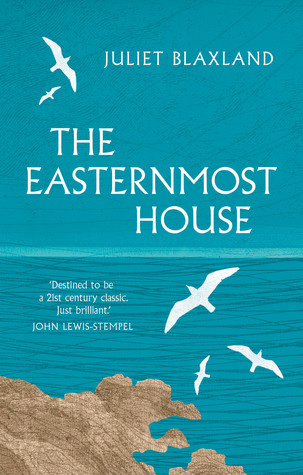
The Easternmost House by Julie Blaxland

4 out of 5 stars

A copy of this was provided free of charge from the publisher in return for an honest review.

I have loved the sea and coast for as long as I can remember. Every day that you visit is different because one of the numerous factors has changed and I like the dynamics of the constantly changing light and tides. I would love to watch a winter storm from the cosy confines of a secure house too.  However, for some people there is too much change where the land meets the sea. On the very eastern cost of our country, erosion of the soft cliffs there is happening at a dramatic rate.

The house on the edge of the cliff was demolished this week, which means we are now the house on the edge of the cliff.

Juliet Blaxland is one of those living on this fast-changing coastline. Way back in time there used to be a village there and in 1666 the church succumbed to the waves. The battle between sea and land has continued until now. Back in June 2015, her house was 50 paces from the cliff edge. Now, it half that and getting closer year on year. One day their home will have to be demolished, they just don’t know when that day will be.

It is not just a book about the frightening rate of erosion, but about living a life in a place that she loves. Moves from wider contemplations on the rewilding of landscapes that mankind has realised that they cannot control to tiny details of day to day life and how that can affect our moods.  She has come to understand that we are momentary beings on a transient planet; our three score and ten on this rock are nothing when compared to the lifetime of the Earth, though it saddens her with the way that is changing so rapidly.

I am not sure that I could live with that inevitable feeling that your home is going to one day fall into the sea, they can lose chunks as much 3m in one single storm. Those that wanted to live closer to the sea are suddenly much closer than they ever thought that they would be. However, Blaxland is quite philosophical about the whole thing. I really liked this book, Blaxland’s writing is evocative, whether she is writing about the roar of a storm, jugs of homemade Pimm’s or the attempt to create a crop circle. She has a deep love of the coastal landscape she inhabits. They still live there and will do until the bitter end.

Hare by Jim Crumley

4 out of 5 stars

The hare is a creature that has been part of our natural landscape for time immemorial and has entered our cultural folklore too, however, few people have seen them, including me. In this charming little book, Jim Crumley recounts three occasions where he has seen this elusive and slightly magical creature, including seeing both species, the brown hare and mountain hare, where the snowline started.

This beautifully produced book is very short. I didn’t so much read it rather, rather inhale it. Crumley has a lovely turn of phrase and a keen eye so reading his books is always a pleasure. This one came from the library, but these are a lovely (if expensive) series of books that I can see myself collecting as I have just bought the one on the fox.

Book Musings – April 2019

April was a reasonable reading month, managed to get through 17 books in total, helped by the long weekend at Easter. Still have a massive backlog of books to read, not helped by buying more!


The AA sent me The Woman Who Rode A Shark. Primarily aimed at children, this book by Ailsa Ross & art by Amy Blackwell tells the stories of 50 women adventurers who have made a difference.

I actually read quite a lot of fiction this month too, South of the Border, West of the Sun was one that I found for a friend and before posting it off to her, read it. I think that it has been my favourite Murakami so far. I read Grief is a thing with Feathers when staying with my wife’s aunt one weekend. I liked it but didn’t love it like some people. Managed to get a copy of Lanny by Max Porter from the library. This story of a boy called Lanny and his place in the natural world has a dark undercurrent of folk horror. I really liked it.


I also read most of the shortlist from the Wellcome prize, including these two fiction offerings, Murmur by Will Eaves and My Year Of Rest and Relaxation by Ottessa Moshfegh. Murmur was the winner of the prize, in the end, but of these two I preferred the other!


The remainder of the shortlist were The Trauma Cleaner by Sarah Krasnostein, Mind on Fire by Arnold Thomas Fanning which is about his descent and recovery from mental illness and Heart by Sandeep Jauhar which is fairly self-explanatory. All were worthy inclusions to the shortlist but my favourite of these, and our Shadow Panel winner was The Trauma Cleaner. Not one to read when you are eating your lunch though.


Gabriel Hemery’s new book, Green Gold is a fictionalised account of the of a Victorian Plant Hunter called John Jeffrey. He has based the story of actual correspondence from the Association that sent him to the west of America in the search of plants and conifers. I thought it was really good.

I had read David Bramwell & Jo Keeling’s book called The Mysterium and realised that the library had The Odysseum. This is about Strange Journeys and things that have happened to people. Not bad overall.

Out of the Woods is a blend of memoir and natural history as seems to be the fashion these days. This by Luke Turner is also an exploration of his bi-sexuality and how he spends time in the forest to get some comfort amongst the trees.

This month poetry book was Sincerity by the Poet Laureate, Carol Ann Duffy. I have only read a couple of her works before but thought this was really good too.

Chris Mullin has written some of the best political diaries of recent years seen from the perspective of the back benches and a brief spell as a Junior Minister. This is a step back and a look at his time as a journalist, his first political stirrings, his marriage and now retirement from political life. Not as good as the diaries, but still worth reading.

Kassia St. Clair’s book, The Secret life of Colour, was really good, so I was looking forward to her next book. I managed to get hold of a copy of The Golden Thread. This wasn’t too bad in the end, but it did have some flaws that showed that it might have been rushed to publication. Fantastic cover though

I have actually met Dan Richards and interviewed him for his previous book, Climbing Days. In fact, the cover of that book adorns the wall of my office with the striking image by Stanley Donwood. I was really pleased to be sent a proof of his new book, Outpost by Canongate. In this, he heads out to visit as many bothys as possible. These small shelters are for walkers and explorers to shelter in overnight before heading onward on their travels. An excellent book that shows how he is maturing as a writer too. Looking forward to hearing his next project.

Monisha Rajesh’s first book was about taking 80 Trains around the colourful country of India. Her next book, was the logical next step up from there, Around the World in 80 Trains.  She is an author that engages with the people around her as she travels and this makes it a far more interesting book to read. Well worth reading.

I first came across David Seabrook last year when I read, All the Devils are Here. In that, he mentioned a series of killings in London and it turns out there was another book that he wrote about those murders called, Jack Of Jumps. It makes for grim reading, but this is still an unsolved murder case even though there has been plenty of speculation as to who the perpetrator was, including Seabrook’s own idea in here. Fascinating, if grim, reading.

Not a bad month overall. My book of the month was Outpost, which I would urge you to read if you can. Are there any here that you have read? Or want to read?

A few other questions for you too:

1. Do you like the summing up posts?

2. Would you like to see a monthly TBR Post of what I am planning to read?

3. Would you like to see blog posts with a more general book centred theme rather than just reviews?

Earth From Space

5 out of 5 stars

A copy of this was provided free of charge from the publisher in return for an honest review.

In December 1972 the astronauts about the Apollo 17 took a photo of the Earth. They were around 18,000 miles away at the time on their way to the moon. This image titled the Blue marble has become one of the most reproduced images in the world. It shows just how magnificent our tiny planet is and also just how fragile it is too.

The new book, Earth From Space, aims to show how our planet looks now using the latest high-resolution camera fitted to satellites. Split into four sections, Movement, colour, pattern and change, these images are just jaw-dropping. There are images from all over our planet on some of the most spectacular sights, both man-made and natural that they have found, from river deltas, to brand new islands created by volcanoes, a network of rice paddies to the latest technology in finding whales. There is an image showing the tidal range around Mont Saint Michel and even more spectacular the flow of current from the Atlantic to the Mediterranean.

This is an amazing coffee table book with a solid five stars. I’m all out of superlatives for the images which really work in this large-format book. The text that accompanies them is useful but is primarily there as a foil for the photographs really. Some of the colours of the places that they take are amazing, not sure how much enhancement they have had though. It is also a timely reminder that we live on an amazing planet and we are as much as a part of the ecosystem as the microbes that permeate all levels of the world. There is no plan(et) B; if we ruin this one, we are all doomed.

Green Gold by Gabriel Hemery

Welcome to Halfman, Halfbook for my stop on the Blog Tour for Green Gold by Gabriel Hemery and published by Unbound.


About the Book


In 1850, young Scottish plant hunter John Jeffrey was despatched by an elite group of Victorian subscribers to seek highly prized exotic trees in North America. An early letter home told of a 1,200-mile transcontinental journey by small boat and on foot.  Later, tantalising collections of seeds and plants arrived from British Columbia, Oregon and California, yet early promise soon withered. Four years after setting out, John Jeffrey, and his journals, disappeared without a trace.  Was he lost to love, violence or the Gold Rush? Green Gold combines meticulous research with the fictional narrative of Jeffrey’s lost journals, revealing an extraordinary adventure. 


About the Author


Gabriel Hemery is a tree-hunter, forest scientist and published author. As a young researcher he led a seed-collecting expedition to the walnut-fruit forests of Kyrgyzstan, and in his career as a hands-on scientist has planted tens of thousands of trees in plantations and experiments across Britain. Gabriel played a lead role alongside other prominent environmentalists in halting the sell-off of England’s public forests. After leading the Botanical Society of the British Isles as its first Director of Development, he co-founded the environmental charity Sylva Foundation, since leading it as Chief Executive. His first book The New Sylva was published to wide acclaim in 2014. He lives near Oxford in England.


My Review

In the middle of the 19th century, the fervour amongst the great and the good was reaching fever pitch for the plants that were yet to be discovered. A committee was formed, the Oregon Association, with the intention of sending someone out to North America where the riches pickings were available, and potentially the wealthiest return. A gardener from Edinburgh’s Royal Botanic Garden called John Jeffery was interviewed and appointed and charged with the collection of seeds and cones and to be returned to the subscribers of the Association. He was asked to keep two journals and to send regular correspondence and packages back to the UK.

Jeffery left the UK in mid-1850 and headed northwards. After a stop in Orkney, he arrived on the North America Continent in August. He wrote to the Association saying that he had arrived and then the toughest part of his journey was about to begin as he was to travel 1200 miles across snow, mountains and harsh landscape towards the Columbia River where he could begin his great commission. Over the next four years, carefully curated packages of seeds along with notes of the plants and their locations would arrive back in Scotland for the subscribers to the Association to share amongst themselves. Apart from the odd letter though, he never kept his promise to supply the journals of his travels. Eventually, the Association, who thought they were going to get untold botanical riches from their collector were disappointed with the packages sent back. They set about dismissing him from his post. Before anyone representing the Association could find Jefferies to inform him of this decision, he had vanished off the face of the earth when travelling from  San Diego across the Colorado Desert.

I have never been a huge fan of docu-dramas, so when I first realised that this was a fictionalised account of John Jeffrey my heart sunk a little. However, Hemery has worked wonders here. Relying on extensive research combined with reproductions of the correspondence between all the interested parties his has written a compelling story of what Jeffrey’s might have been in the lost journals about his travels across the very much Wild West in the search of plants for his employers. At the time of his collections, the disappointment of the Association was very evident, though they did not cover themselves in glory with the organisation of the trip, it turns out that his discoveries were more significant they realised. An unexpected good read.


Don’t forget to visit the other blogs on the blog tour


Buy this at your local independent bookshop. If you’re not sure where your nearest is then you can find one here

Gabriel has an absolutely fascinating website: GabrielHemery.com or you can follow him on Twitter here @GabrielHemer

My thanks to Unbound for the copy of the book to read and to Anne Cater from Random Things Tours for arranging everything for this blog tour.

« Older posts Newer posts »

© 2026 Halfman, Halfbook

Theme by Anders NorénUp ↑