Page 37 of 185

The Four Horsemen by Emily Mayhew

4 out of 5 stars

A copy of this was provided free of charge from the publisher in return for an honest review.

The four horsemen. War, Pestilence, Famine and Death appear in the Bible a couple of times, but they are best known in the book of Revelations. Their appearance on the Earth in this text is to bring about the end of humanity and they are pretty effective at their job. History shows how they can reduce cities and societies to a shadow of their former selves.

It can still happen these days, examples include Syria and Yemen. However, the tools that we have at our disposal in this modern age mean that we now have the ability to take them on. I this book, historian Emily Mayhew traces the advances in science, technology and humanitarianism that the engineers, scientists, doctors and other skilled professionals are using to combat these four horsemen.

In the book, Mayhew takes us through a little of the history behind each, before using real-life examples, to show exactly how we are standing up against these spectres. She details the way that the Iraqi city of Mosel was overrun with ISIS fighters and how the local people slowly reclaimed their ancient city. For the chapter on Pestilence, she looks at the response that the authorities had against the Ebola outbreak in the Democratic Republic of Congo in 2017. This was a precursor to the Covid pandemic that also is discussed.

The next horseman is famine. This slots in neatly behind the first two and has the capacity to bring a state or region to its knees. One example discussed in this chapter is wheat rust. One particular form appeared in 1999 and then promptly disappeared for a few years. When it returned, it suddenly was rife across East Africa. The other example discussed is bananas, the current species that is consumed in vast quantities is affected by Panama disease. Fighting this may mean going back to the jungles of New Guinea and finding a new resistant species. The final chapter, Death talks about the relief response to the tsunami that took place in 2004 along with other disasters that have claimed huge numbers of people. How the dead are handled with respect to the local cultures by the people that deal with the aftermath is quite moving reading.

I thought this was going to be a pretty grim read, and to my surprise, it wasn’t. That said, there are some grim elements to it, it is kind of inevitable really given that the subject is about the four horsemen of the apocalypse. However, Mayhew makes this eminently readable by looking at each of them in turn and explaining what used to happen and how the collective actions of scientists, medical staff and engineers who are pushing back again the potential tide of misery with solutions for the many problems that we face as a race.

The Antisocial Network by Ben Mezrich

3 out of 5 stars

Playing the stock market can be addictive there are thousands of people out there trying to make a fortune by thinking that they have that edge of hugely expensive computer systems and superfast fibre optic networks that the main players and hedge funds have. Most they can’t win against the might of the financial industry.

But every now and again there is a story of the little guy fighting back and managing to get one over the professionals; this is the story of those people that took down one of the biggest hedge funds on Wall Street. The stock that caused this was the retail shop called GameStop. They had not migrated online and still had a plethora of shops. Because of the transfer of the gaming industry to almost exclusively online, their financial position looked precarious. Big hedge funds were circling, they were looking at shorting the stock with the intention of making a lot of money as the share price fell.

Against them were a motley crew of amateur day traders, video game nuts, and internet trolls who were getting their financial information from a page on Reddit called WallStreetBets. On this page, people were not afraid to say exactly what they thought of companies and their share prices. A few of the members noticed that GameStop looked in better financial shape than the heavyweights of Wall street thought.

Mezrich has fleshed out the story of the stock stratospheric rise and we see that story from some of the major characters involved and the agony and delight as they won and lost fortunes every time the share price changed. I can recall this being aware of this at the time from some of the stuff I was reading from some of the people that I follow on Twitter at the beginning of 2021, however, I didn’t know much detail as I wasn’t following it in any depth so this was a learning curve for me. I thought that the narrative in this book was a bit disjointed because he switches to a different person in each chapter and it always takes a moment to work out where the story is going next. It did show what the little guy can do, however, even though they won some victories in this stock shorting game, the system always wins in these financial battles. Wel will have to see if anything changes.

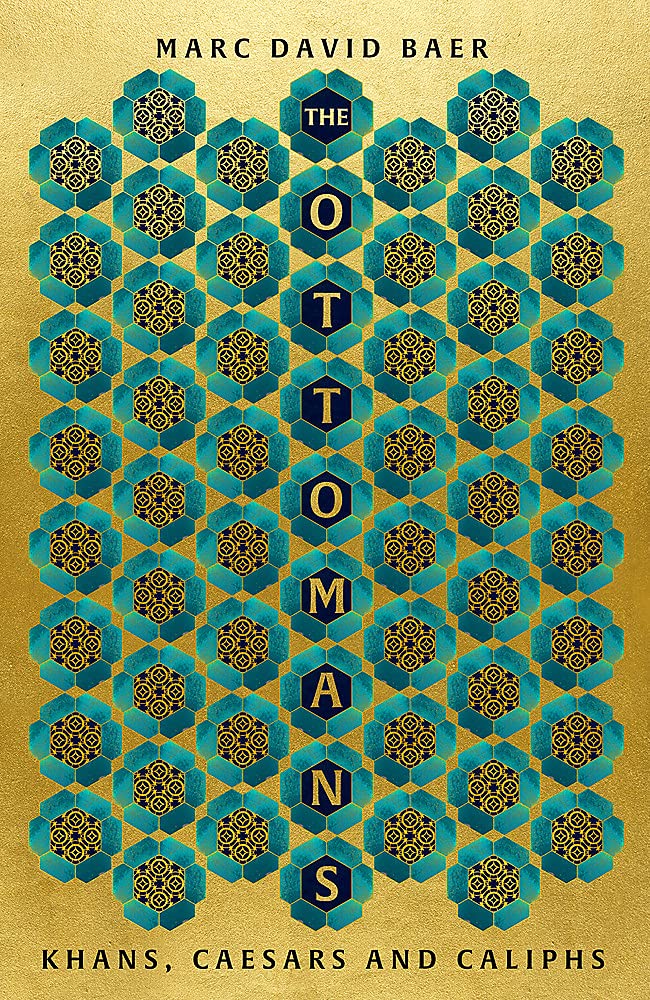
The Ottomans by Marc David Baer

Welcome to Halfman, Halfbook for my stop on the Blog Tour for The Ottomans by Marc David Baer and published by Basic Books.

About the Prize

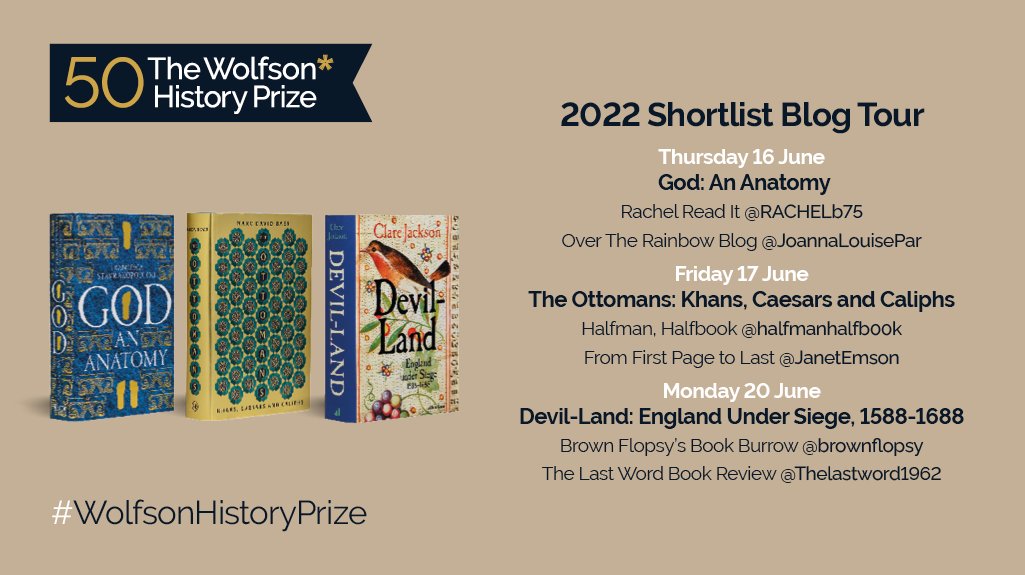
The Wolfson History Prize, which celebrates its 50th anniversary this year, is the UK’s most prestigious historical writing prize and was created to champion the best and most accessible historical writing, and to highlight the importance of history to modern life. Previous winners have included Mary Beard, Antony Beevor, Antonia Frasier, Sudhir Hazareesingh, Amanda Vickery and many more.

A number of the six titles in the running for the £50,000 prize (making it the UK’s most valuable non-fiction writing prize) prove that current social divisions are nothing new, exploring times of discord and crisis throughout history, including accusations of witchcraft in a small New England town, the shock of Britain’s European neighbours during the turbulent Stuart dynasty, and the topical question of fallen statues and what they tell us about historical legacy.

Other titles on the shortlist showcase the impact faith has had on our lives over the centuries, tackling subjects such as the role of religious tolerance within the Ottoman Empire, the surprising realities of Medieval churchgoing, and the ways in which the anatomical concept of God has changed across time.”

To learn more about the Wolfson History Prize please visit https://www.wolfsonhistoryprize.org.uk/ or connect on Twitter via @WolfsonHistory / #WolfsonHistoryPrize.

The books shortlisted for the 2022 Wolfson History Prize are:

The Ruin of All Witches: Life and Death in the New World by Malcolm Gaskill (Allen Lane)

Devil-Land: England Under Siege, 1588-1688 by Clare Jackson (Allen Lane)

Going to Church in Medieval England by Nicholas Orme (Yale University Press)

God: An Anatomy by Francesca Stavrakopoulou (Picador)

Fallen Idols: Twelve Statues That Made History by Alex von Tunzelmann (Headline)

And the book I am reviewing today:

The Ottomans: Khans, Caesars and Caliphs by Marc David Baer (Basic Books)

About the Book

The Ottoman Empire has long been depicted as the Islamic-Asian antithesis of the Christian-European West. But the reality was starkly different: the Ottomans’ multiethnic, multilingual, and multireligious domain reached deep into Europe’s heart. In their breadth and versatility, the Ottoman rulers saw themselves as the new Romans.

Recounting the Ottomans’ remarkable rise from a frontier principality to a world empire, Marc David Baer traces their debts to their Turkish, Mongolian, Islamic and Byzantine heritage; how they used both religious toleration and conversion to integrate conquered peoples; and how, in the nineteenth century, they embraced exclusivity, leading to ethnic cleansing, genocide, and the dynasty’s demise after the First World War. Upending Western concepts of the Renaissance, the Age of Exploration, the Reformation, this account challenges our understandings of sexuality, orientalism and genocide.

Radically retelling their remarkable story, The Ottomans is a magisterial portrait of a dynastic power, and the first to truly capture its cross-fertilisation between East and West.


About the Author

Marc David Baer is Professor of International History at the London School of Economics and Political Science. He is the author of five books: Honored by the Glory of Islam: Conversion and Conquest in Ottoman Europe, winner, Albert Hourani Prize, Middle East Studies Association of North America; Sultanic Saviors and Tolerant Turks: Writing Ottoman Jewish History, Denying the Armenian Genocide, winner of the Dr Sona Aronian Book Prize for Excellence in Armenian Studies, National Association for Armenian Studies and Research; The Dönme: Jewish Converts, Muslim Revolutionaries, and Secular Turks; German, Jewish, Muslim, Gay: The Life and Times of Hugo Marcus; and The Ottomans: Khans, Caesars and Caliphs.


My Review

The Ottoman Empire controlled a large part of Southeast Europe, Western Asia, and Northern Africa between the 14th and early 20th centuries. It crushed the Byzantine Empire and after it won in the Balkans it became a genuine transcontinental empire. It has been perceived in history as being the Islamic foe of Christian Europe, but the reality was utterly different, it was a multiethnic, multilingual, and multireligious society that accepted people from everywhere.

They were keen on converting people to Islam, but this was not a prerequisite to being a member of this society. Jews that were fleeing European persecution found a home here and could even rise high in the elite service of the sultans. In fact, the tolerance and acceptance of a whole variety of peoples became its strength over the greater part of its history.

The book follows both the political leaders of the empire over the six centuries of rule. The way that each new sultan would put to death brothers and cousins to ensure that they had no threat to their leadership was shocking reading. For me, I found, the descriptions of the way that the society worked and the cultural aspects much more interesting reading.


To say there is a lot to take in in this book is an understatement. Baer covers the 600 years of the ebb and flow of the history of this empire in a remarkably readable book. It has a strong narrative and only occasionally descends into detailed academic prose about very specific or particular events. It also shows that Ottoman history is unequivocally European history too.


Don’t forget to visit the other blogs on the blog tour


Buy this at your local independent bookshop. If you’re not sure where your nearest is then you can find one here


My thanks to Bei from Midas PR for the copy of the book to read.

Otherlands by Thomas Halliday

3.5 out of 5 stars

We have had life on this planet for a substantial period that it has been whirling around the sun. But the life that you will find is significantly different to the plants birds and animals that we can find around us now.

In this fascinating book, award-winning palaeobiologist Thomas Halliday will take us back to the dawn of time and talk us through the flora and fauna across all of the seven continents from Scotland, to Chile, Italy, Australia and Alaska to China.

In each of these locations he takes us on an immersive journey into the animals that you were likely to see should you be able to step out of a conveniently located time machine. Each chapter is packed with this level of detail and sadly this density is almost too much at times and I ended up skimming it a little.

Whilst I liked it, it was like reading the screenplay of an Attenborough documentary where someone had described every leaf and creature in each shot. I did feel that the epilogue kind of didn’t fit in with the rest of the book, but I get why he included it. It is a warning to say that where we are heading with the climate has happened in the past and it wasn’t a particularly easy time for life on earth. Not bad overall.

Mind Is The Ride by Jet McDonald

3.5 out of 5 stars

A journey begins with an idea, for the late Dervla Murphy it was getting a bicycle and an atlas and conjuring the idea in her head to cycle to India. McDonald wants to undertake a similar journey with his partner, but rather than doing just because he can, he is wanting to use the journey to explore the realms of philosophy and each component of the bike as well as the epic ride.

Whilst the trip is the important part of the trip, we read about the usual things that trouble a touring cyclist, the main focus of the book is the consideration of the philosophical idea that we use to determine who we are. Each chapter consists of the three themes of the book, intellectual exploration, his actual travels and the contemplation of the numerous components that go to make up a regular bicycle.

It is certainly one of the most unusual travel books that I have read. I liked certain past of this, but I didn’t get along with all of it. I liked the way that the bike was built chapter by chapter taking each significant component, even down to the individual tubes of the frame and assembling the bike as he cycled to India. I liked the travel elements too, and whilst I realise that this was not the entire reason behind the book, I would have liked more of it. For me, there was a slightly too much emphasis on the philosophy and I kind of wish that there was more of the travel writing in it. McDonald makes the subject interesting to read and I much preferred this to Zen and the Art Of Motorcycle Maintenance.

Notes From A Summer Cottage by Nina Burton

3 out of 5 stars

Nina Burton had always stayed in a cottage in the brief Scandinavian summer and after her mother passed away she sold her apartment and bought a country cottage deep in the Swedish countryside. It needs some improvement and this book is the story of the time spent there as the renovations took place and her discovery of the natural world around the cottage.

The work required was quite substantial and the workmen began with the roof. Not only did the roof have almost no insulation, but the little that was, had been used by a squirrel to make a nest so it could keep warm. For each of the animals she encounters, for example, pigeons, badgers, blackbirds and ants who are literally in and around the house there are stories to tell.

Burton is quite a keen observer of the plants and wildlife around her. The writing isn’t too bad either, quite matter of fact mostly, but she does have a habit of going off on a tangent. I must say that I disagreed with her using poison to kill some of the creatures that she was sharing the forest with. They have been there much longer than she has and hopefully will be there long after too. Not bad overall, but not the best that I have read.

The Suburbanist by Geoff Nicholson

4 out of 5 stars

A copy of this was provided free of charge from the publisher in return for an honest review.

I haven’t lived in many places, but all of them so far have been in some sort of suburban setting, though I am fortunate that where I am now I can be in the beautiful Dorset countryside in a few minutes. Believe it or not, the suburbs have been around since the late 19th Century and it was the social reformers back then who gave it the identity that we know now.

Even though lots of people live in them, they are not always seen as a cool place by the intellectuals and avant-gardists who hold them in some contempt. Never unstop why. Nicholson though knows them well and this is almost a eulogy to them. He realises that they have their failings as well as their detractors, but draws his own conclusions as to why these people have those opinions on where he has chosen to live.

He wanders around the suburbs that will take him from the depths of Woking (where I have lived) and Stanley Road, the most famous son of this road is Paul Weller. He talks about the history of these places and the beginnings of the garden cities. He has a rummage on his bookshelves to see what lies in wait for the bookworm and even considers the suburbs as portrayed on the television which inevitable means The Good Life and Terry and June (yes I am old enough to remember that!).

One of the things that set the suburbs apart from the city dweller is the garden and there are a couple of chapters about people’s obsessions with these including discussions about the fine art of topiary. He even pays a visit to Poundbury, the town that is the brainchild of Prince Charles and is located just outside Dorchester. Even though a friend and neighbour has been involved with some of the planning of the properties there, I am not a fan of the place.

I really liked this. Nicolson has a quirky way of looking at the suburbs which I found really appealing. I liked the way that he has woven his personal stories of living in the suburbs in the UK and the USA into this book. An observer looking in would not have that same insight and it feels more authentic because he knows what it is like to live there. If you have read Outskirts by John Grindrod then I think that this would be a book you’d like too.

No Friend But The Mountains by Behrouz Boochani, Tr. Omid Tofighian

4 out of 5 stars

In 2013, Kurdish journalist Behrouz Boochani was aiming to seek asylum in Australia but first he had to get there. The book opens with him in a truck on the way to a boat that he hopes will take him there. He knew of the stories of boats that were not seaworthy and would sink on the journey over. But he never thought it would happen to him. It did. The story of the boat he is on sinking is terrifying enough, but he is one of the fortunate ones to be plucked from the ocean to safety.

The waves have freed us from their clutches /
The waves have spared our lives /
I laugh at them /
I laugh in triumph /
Laugh to express the feeling of victory deep inside

He goes from a water hell to a fiery hell. Along with a load of others he is deported to the notorious detention centre on Manus Island. In this place, he tells the story of himself and other prisoners who are detained and treated with the most inhumane contempt. He tells his story of survival in this place as well as the stories of those around him.

We are four hundred people /
Four hundred lost souls in a tightly confined space /
four hundred prisoners /
Anticipating the nights we can leave /
. . . so we can leave /
. . . and enter our nightmares.

There is no denying that this is a grim read. The prison is full of cruel people, both immigrants and the warders, but there is still humanity in some of the things that he witnesses. Most amazingly, this was written one text at a time from a secret mobile phone in prison sent to someone on the outside and was translated and published before he was released. He has now been granted asylum in New Zealand and from what I can gather is making a new life for himself. It is not the most literary of books but should be necessary reading for those trying to understand how unnecessarily horrible most asylum seekers are treated.

Silent Earth by Dave Goulson

4.5 out of 5 stars

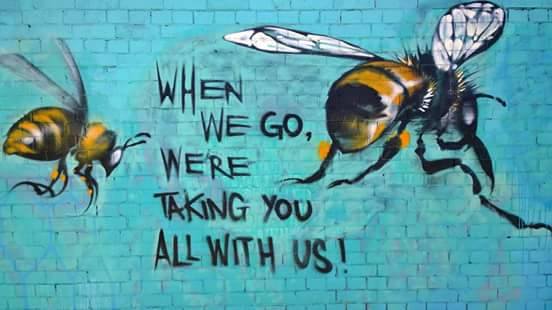
People seem to forget that we are an integral part of the natural world and this planet. Ultimately, everything that we do will have an effect and repercussions much further down the line. This piece of art by Jim Vision and Louis Masai says it all really:

One of the creatures that we really have to look after is insects. They are essential for life in so many ways, so of which we know and as Goulson, says in the book, echoes Donald Rumsfeld of all people, in ways that we have not even begun to comprehend. As they disappear because of our actions; spraying vast swathes of land with toxic chemicals, drenching plants with weedkillers and pumping vast quantities of climate-changing gasses into the atmosphere, the world as we know it will change irrevocably.

Goulson is drawing all his scientific knowledge to do two things in this book. The first is to show the shocking and often cataclysmic decline in insect populations that have taken place in recent decades and the reasons why this has happened. The second is to show how and why we need change at every level of government and society. We have to look after these invertebrates; our lives depend on them.

This is not an easy book to like, but sadly it is a necessary final warning shot across the bows as our species wreaks havoc across the world. The focus in this book is on Goulson’s favourites, the insects, however, he lays all of the facts out very clearly and draws on the evidence provided by science about the devastation that we are causing. It would be nice to think that this could be read by more MPs, who are in a position to do something about it, but I fear that it won’t be. It is a sobering and vitally important read.

The Great North Road by Steve Silk

4 out of 5 stars

I have been up and down the A1 on a few occasions, but it is not a road that I know that well. The road that it replaced, the Great North Road, ceased to exist in 1921, but if you knew where to look on the maps then you could still trace the route from London to Edinburgh.

For the centenary of this moment, Steve Silk has decided that he wants to try and follow the 500-mile route (there is a song in that) over 11 days as best he can on his bike. He wants to see if he can find the old coaching inns that were described in the book by Charles G Harper who undertook a similar journey on a bike which at the time was a new technology.

He doesn’t begin the journey in the oddly named street of St Martin’s-le-Grand, where the mail coaches began, he has chosen a bike café nearby. He has his photo taken with his old fashioned bike, a Jamis Aurora and heads out into the London traffic. A very angry skip lorry driver nearly makes sure that is as far as he gets, but he survives and he is soon passing the M25 on the way to the first day’s stop Stevenage.

His chosen route will take him through and past towns and cities such as Stevenage, Doncaster and Newcastle. However, the real jewels of this journey are the villages that he passes through and the stories that they have to tell him. He gets to meet and eat the Bedfordshire Clanger (not from the TV series), discovers who ‘Drunken Barnaby’ is, goes to see the Devil’s Arrows and visits many battlefield sites.

I think Steve has taken a simple premise and made a really good job of writing a interesting and entertaining book about parts of the UK that I know only a little about. It is about the ride, but it is also about discovering more about the places he travels through. He is endlessly curious and sees everything with a journalist’s eye and finds the nuggets of information that reveal our rich and varied past. I liked that he wasn’t trying to break any records, it was just him and his bike and hundreds of years of history to explore.

« Older posts Newer posts »

© 2026 Halfman, Halfbook

Theme by Anders NorénUp ↑