Page 43 of 185

The Nutmeg’s Curse by Amitav Ghosh

4.5 out of 5 stars

It was almost a point of no relevance, but at the beginning of this sorry tale, a lamp fell onto the floor. It happened in a dwelling on the Island of Banda and rather it is seen for what it actually was, a mishap of no real significance, it was the start of the clearance of the islands. Sonak, a Dutchman, was there to remove the people from their homes and to take the nutmeg from them. The crash of the lamps as it hit the floor was thought to be an attack on that place and they begin shooting at random.

It is this moment that Ghosh thinks was the beginning of the present climate crisis as well as the current imperialism that still dominates the world. This relentless greed has driven countries and companies to eradicate people and places for the resources that were once theirs. That same philosophy where the earth is seen as a source of materials and therefore a source of money is still prevalent today, just look at the way that oil companies work in ensuring that their income streams are not restricted by local people who want to live in a safe environment.

Gosh uses lots of examples to demonstrate this point and show how these inequalities are deeply rooted in our present western culture. He also looks at how indigenous people use the resources available to them in a sustainable way and how this Traditional Ecological Knowledge (or TEK) is showing how these people used the planet in ways that could keep going indefinitely. This indigenous knowledge has gone from most western cultures and with that we have lost the ability to learn the stories of the land. Seeing the planetary crisis through the eyes of a shaman is quite startling.

Yes I have learned the names of all the bushes, but I have yet to learn the songs

This is not an easy book to like as it subject and content make for fairly grim reading. That said, Ghosh has written an important book about the roots of our present dilemmas, climate change and geopolitical power that can be traced back to the Isles of Banda. I tend to agree with his conclusions, that seeing the planet purely as a source of resources to be exploited to the nth degree has led us to this point. These vested interests are keeping us in this cycle of destruction, but as he hints at the end of the book in his conclusions, there is a glimmer of hope.
March 2022 TBR

And another month passes and it is time again to post my frankly ridiculous TBR. So without further ado, I am aiming to read around 18 of these:


Reading Through The Year

A Poem for Every Night of the Year – Allie Esiri

Word Perfect – Susie Dent


Finishing Off (Still!)

Lotharingia – Simon Winder

Opened Ground Poems 1966 – 1996 Seamus Heaney

Wintering – Katherine May

Ice Rivers – Jemma L. Wadham

Moneyland – Oliver Bullough

Concretopia – John Grindrod

No One Round Here Reads Tolstoy – Mark Hodkinson

Wild Fell – Lee Schofield


Review Copies

Hurricane Lizards And Plastic Squid – Thor Hanson

Isles at the Edge of the Sea – Jonny Muir

The Good Life: Up the Yukon Without a Paddle – Dorian Amos

Shalimar – Davina Quinlivan

Who Are We Now? -Jason Cowley

The Year the World Went Mad – Mark Woolhouse

Astral Travel Elizabeth Baines

Britain Alone – Philip Stephens

We Own This City – Justin Fenton

Spaceworlds – Ed. Mike Ashley

The Power of Geography – Tim Marshall

The Four Horsemen – Emily Mayhew

The Spy Who Was Left Out In The Cold – Tim Tate

The Devil You Know – Gwen Adshead, Eileen Horne

Letters from Egypt – Lucie Duff Gordon

Crawling Horror – Ed. Daisy Butcher & Janette Leaf

The Valleys of the Assassins – Freya Stark

The Cruel Way – Ella Maillart

Above the Law – Adrian Bleese

Cornish Horrors – Ed. Joan Passey

Somebody Else – Charles Nicholl

Scenes from Prehistoric Life – Francis Pryor

The Turkish Embassy Letters – Mary Wortley Montagu

Black Lion – Sicelo Mbatha

The Babel Message – Keith Kahn-Harris

The Heath – Hunter Davies


Library

Looking for Transwonderland – Noo Saro-Wiwa

Putin’s People – Catherine Belton

Forecast – Joe Shute

The Nanny State Made Me – Stuart Maconie

The Great North Road – Steve Silk


Poetry

The Waste Land – T.S. Eliot

A Choice of Emily Dickinson’s Verse – Emily Dickinson, Ted Hughes


Books to Clear

Our Game – John Le Carré

The Tailor of Panama- John Le Carré

Year of the Golden Ape – Colin Forbes

Dreaming in Code – Scott Rosenberg


Challenge Books

Hebrides – Peter May & David Wilson

The Wood That Made London – C.J. Schuler

English Pastoral – James Rebanks

Wild Silence Raynor Winn


Photobook

Hebrides – Peter May & David Wilson (also a challenge book!)

So, er, that is it. Inevitably there will be library books that have to be read as others have reserved them. Either way, I win!

Any in that list that you like the look of?

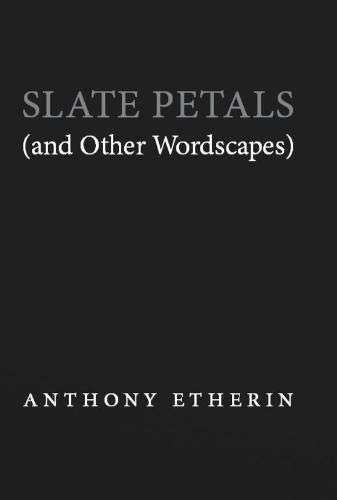
Slate Petals by Anthony Etherin

4 out of 5 stars

A copy of this was provided free of charge from the publisher in return for an honest review.

I haven’t been reading poetry for very long so each book that I pick up from all manner of poets is a discovery of what is possible. A lot of the poems that I have read this year have varied from the classics like Heaney to more up to date material from contemporary poets. For me the joy of poetry is the way that the author can extract the most amount of meaning from the fewest words; I try to read each poem as it stands too rather than having to extract the meaning from every word.

They have all followed similar patterns too, but then I picked up Slate Petals. This is unlike any other poetry collection that I have read before. There are poems that are images, I Leave Torn is a series of images of torn letters rearranged into a neat shape, Marionette Noir a.m. is a musical notation and Noir of Orion is the constellations arranged in a series of different forms.

There are regular forms and stanza too, but Etherin uses form, structure and layout in a quite unique way, for example, those that have been typeset to mimic the subject matter of the poem. I particularly liked the poems within poems that used subtly different font colours. If you want a poetry collection that will challenge everything that you thought possible this is a good place to start.

Three Favourite Poems
Winter Solstice
Early Sun
Oblivion

A Natural History of the Future by Rob Dunn

5 out of 5 stars

A copy of this was provided free of charge from the publisher in return for an honest review.

We have accumulated the knowledge and power to be able to shape the very surface of this planet to our will. We have changed almost every square kilometre of the land surface either directly or affected it in some way or another.

We are masters of this planet, or at least we like to think we are.

Our rate of expansion has been immense. Around 50,000 years ago there were a few thousand humans and now we are about to go past eight billion. We have had such an effect on the planet that we have created our own epoch, the Anthropocene. We make up just over 30% of the entire biomass of the planet and consume its resources at ever rapid rates.

The way that things are changing with the havoc that we are causing means that lots of species are suffering from declines in numbers, sometimes drastically and in some cases going extinct. As these life forms disappear, that has a huge knock-on effect as everything is interconnected. And as it turns out not even we human beings can adapt at the pace that we are changing the planet. Places that we have once been able to live in are now becoming uninhabitable and there is the worrying rise of variability; where there is not a steady change in a particular direction, rather there are extremes that are much more difficult to cope with.

Using various examples he explains how our enormous footprint on the planet is affecting everything in ways that we cannot foresee, how species are being isolated and are changing and also how the simple use of a wildlife corridor can have great benefits. As humanity has moved around the planet we have taken our crops with us and adapted them to the new locale so we have brought with us numerous pathogens. Most of them have been harmless until now, but Dunn gives several examples where this is changing.

He explores how our current monoculture of food production may cause problems, what we need is diversity now to be able to cope with the dramatic changes that are starting to happen. The lack of diversity in the species will also cause problems and he goes into some detail on our dependence on the microbes that live in and on us and mostly keep us healthy and how a simple medical procedure is having an effect of the way that these are passed on between mother and child.

Even though this could be pretty gloomy at times and occasionally terrifying, I thought that it was excellent overall. Dunn knows his subject well and more importantly manages to get across all the salient points in a clear and concise manner. I felt that I was learning something on almost every page. He doesn’t go into much detail on how we can fix these problems, though to be fair that is an entire book in its own right. Rather he wants to present the problems and hope that we can work together to solve them. Essential reading I think.

The Almost Nearly Perfect People by Michael Booth

3.5 out of 5 stars

I have never been to any of these countries yet, however, when I think of Scandinavian countries a have a list of things that come to mind. Danish bacon, ABBA, Ikea, Saab, ultra-cool F1 drivers Viking and Nokia to name a few. The traits of the people that live there come across as relaxed and their societies seem to be the type that looks after the whole rather than the few.

But what are they actually like? I genuinely have no idea, but Michael Booth intends to bring some insights to their national characters in this book. Even though he is English, he has an advantage as he is married to a Danish lady and is resident in the country with her and their family. In this book, he is intending on finding out more about the different nations and seeing if there really like each other.

He begins in Denmark, of course, and set about trying to understand just what makes them tick, what the hell hygge actually is. As he lives there he has more insight into this country’s funny little ways, mostly because he has adopted them himself. There is an interlude as he heads to Iceland, which bemused me as to why it was in the book, as it is strictly not Scandinavia at the moment. Perhaps he should have gone to Greenland, which is at least owned by Denmark.

Each of the countries has a chapter on it and whilst some of the questions he sets about answering in the book are very light-hearted, he does ask some searching questions of some of the people that he meets. He questions politicians about the protective cultures that have a growing proportion of people who are supporting right-wing parties and have citizens who are asking questions about the number of immigrants. Then he is trying to provoke others into reacting as he decides to ignore all social norms in a city centre.

I liked this overall, but I did have a couple of issues with it. Firstly, it became a little bit repetitive at times, similar themes would appear in each chapter for each country. Secondly, it did feel a little bit contrived, rather than him being honest about his feelings for each of the nations he did follow the national tropes that they all have with each other. His prose is quite engaging though and there are quite a few laugh-out-loud moments in the books; I learnt that Ikea names its doormats after Danish towns for example. If you are expecting an in-depth study of each culture then you might need to look elsewhere for more understanding of each of the cultures

Sea People by Christina Thompson

4 out of 5 stars

The Pacific is a vast ocean and I mean vast. When seen from space as the Earth rotates it takes us one complete half of the globe. It is 12,000 by 10,00 miles and all the landmasses on the earth can fit inside this area with still room for a second set of the American Continents. From space, it looks empty, just endless waves and swell and the ocean ebbs and flows with the tides.

But f you were to zoom in then suddenly specks of land appear in the blue. There are around 10,000 islands in this ocean. When the European explorers arrived several hundred years ago they often missed them. You can see why, because at sea level you would be hard pushed to see them unless you knew where to look. Or more importantly, knew how to find them in the endless water. Even in the modern age, these three regions of islands, Melanesia, Micronesia and Polynesia can be troublesome to navigate.

There have been people here living on these tiny dots of sand for a thousand years. They can trace their roots back to a group of voyagers who set out into the unknown ocean. This book is their story.

Thompson is well placed to write this, she is married to a Maori and him and his sons can trace their lineage directly back to these people. As they spread over the islands they developed their own societies, culture and folklore as well as learning how to read the waves and the swell and use the night sky to move between the island showed them where the next land was. It was something that the Europeans could not do, they would either miss them or come across them by accident.

The vessels that they used to get between the islands were specially designed for the sea journeys and were easy to make with the scarce resources that they had. She goes back through their history tracing their expansion across the ocean and they are chapters on how people tried to work out how they could be such successful navigators. They didn’t have metals and it was only relatively recently there it was discovered that they did have pottery when sites were excavated.

I thought that this was a fascinating book about a place that I knew almost nothing of before reading it. Her prose is sensitively written and well researched and the facts and details she reveals are fascinating. The people that populated the Pacific have a fairly unique set of skills when it comes to navigation across this vast ocean and Thompson teases out the details of the way that they manage it. If you want to learn more about how humanity is capable of adapting to the challenges that the planet throughs at it then I would suggest reading this book.

Orchard by Benedict Macdonald & Nicholas Gates

5 out of 5 stars

If I had enough land I would plant an orchard. Sadly I haven’t got that opportunity so I have to make do with visiting the few community orchards every now and again. The one tucked away behind the church in Bridport is one of my favourites. I knew they could be a haven for wildlife, but having read this book, I think that the diversity and range of habitats that they offer is second to none.

This particular orchard that is the subject of the book is quite special. To start with it hasn’t been grubbed up to satisfy the whim of some anonymous civil servant who needs for complete form of some kind, nor has it been touched by chemicals. Sadly they keep its location secret as it is a private orchard as I would love to be able to visit. Instead, they become our eyes and ears looking at the wildlife that inhabit the fruit trees.

The owners of the land do maintain it, but they are happy to leave fallen branches to rot down providing many more habitats for the vast numbers of species that can be found here. With the abundance of insects in the orchard, come their predators and the orchard is full of numerous species of birds, who have plenty of place to nest because of the light touch management of the orchard by the owners. With an abundance of birds come the raptors and this orchard is rich in those too.

I thought was an excellent book. Not only is it packed full of the tiniest details of the life that inhabits this very special orchard, but it is really well written by both the authors. Their writing is evocative and they are happy to share their extensive knowledge with the reader. But most of all it is an inspirational book about how we can use the orchards we have to give wildlife the urgent helping hand it needs in this climate emergency.

Everything You Ever Wanted to Know About the Universe By Andrew Newsam

3.5 out of 5 stars

A copy of this was provided free of charge from the publisher in return for an honest review.

We are fortunate that just north of us we have a designated dark skies area, Cranborne Chase where there is so little artificial light that the magnificent spectacle that is the night sky can be seen in all its glory. But knowing what each of those pinpricks of light is many lifetimes work for scientists and astronomers.

For the layperson, though it can be a bit overwhelming. The distances between each of the stars are mind-bogglingly large. I still can get my head around some of the numbers quoted from us to our nearest neighbouring star, Proxima Centauri. It is four light-years away and you can’t even see it unless you have a telescope!

To help find your way through the vastness of space, Andrew Newsam, Professor of Astronomy Education and Engagement has written this guide for those that want to know a little bit more about the heavens. He has split the book into five sections, a brief history of observation of the stars and planets, a chapter on the sun, the star that gives us heat and light and the solar system. He then moves onto other stars and then galaxies, before ending with a chapter going right back to the very beginnings of the universe when the big bang happened.

As an introduction to the sun, planets and stars that we can see from our pale blue dot, this is a great way of finding out a little bit more about them. Newsam writes in a way that is not too technical but is drawing on his experience as a Professor in the subject. If you are looking for more detail there are other books out there that will fill in the gaps. The only thing that I thought it was missing was a further reading section for those that want to use this as a stepping stone for more information about the particular astronomy subject that fascinates them.

Storyland by Amy Jeffs

3.5 out of 5 stars

As Terry Pratchett said, “Imagination, not intelligence, made us human” and we as a species have been telling stories for thousands of years. And until the advent of paper, these were an oral tradition, told between individuals who passed them on in turn. The stories that have come to make our own mythology have in their own way defined who we are now to an extent. In those stories, you can find dragons, giants and other creatures that have not walked these lands in millennia.

The stores that Jeffs has chosen to make up this collection have been split into four chunks, In the Beginning, where she retells the story of how Albion got its name from and the naming of the Humber and the Severn. In the prehistory section, some of the selected stories include how Conwenna saved Britain and the Dragons that Lived Under Oxford. Merlin and Arthur feature heavily in the Antiquity section and the stories in the Middle Ages section bring us right up to the Norman invasion.

I mostly liked this retelling of the myths and folklore that permeate our history. It is beautifully illustrated, and I liked that the stories had been updated to a modern language. That said, I did have a couple of problems with it, even though the stories are written in a modern language Jeffs has taken the liberty to alter some of them subtly too. I personally don’t think that this is necessary as the original stories as we know then are strange and occasionally defy explanation for a reason. The second reason was that after each story was a little vignette of her visiting the place where the events were supposed to have taken place and they felt a bit bolted on. I would have preferred them to be as part of the introduction or afterword to each chapter.

On the Marsh by Simon Barnes

4 out of 5 stars

Unsure whether to buy a home in Norfolk, what swung it for him was the song from a Cetti’s Warbler that he heard as he stood outside the front door. Outside the back door was a patch of marshland that they wanted to make a conservation area and his wife’s careful negotiations meant that they had a home and patch of land that would not be lost to development.

They had an opportunity to buy the land from their next-door neighbour, Barry and worked with the Norfolk Wildlife Trust to ensure that it became appealing to all manner of species. He isn’t really rewilding it, just letting it get on with life and death in all its rich forms and taking time to enjoy it. For their youngest son Eddie who has Down’s syndrome, it became a place of calm, a place where he could ask any question about what he saw around him when they walked out to their bench.

Set loosely over a year, this is a book that acknowledges time passing, and yet the writing makes it feel timeless. There are moments of sheer delight, when he looks out of the window and sees a marsh harrier passing over or the hare that makes the place his home. There are times he gets furious too, not at what he has but at the way we are discarding parts of the natural world without a care for out interdependent futures. There were some great moments too, like when he opens the moth trap, a birthday gift from his wife, both him and Eddie are hooked

What you see is great, but the greater thing is being out there. Not what you look at but what you’re part of. And that is the greatest gift the marsh brings to us. We’re not the audience, we’re participants.

I thought this was really good. I liked that whilst there was participation from his family in the book, they did not overpower the narrative, the marsh and all the life that inhabits it or passes over is the focus. The other participant in the book is his son Eddie and the way that he reacts to the natural world. If you are looking for personal angst in amongst nature, then this is not the book to find it in, rather this is a more mediative book, celebrating the tiny things that happen each and every day as he looks out the window, or sits on the bench with Eddie, drinking apple juice and beer enjoying the evening sun. It is a book to savour and enjoy.

« Older posts Newer posts »

© 2026 Halfman, Halfbook

Theme by Anders NorénUp ↑