Page 57 of 185

Reset by Ronald J. Deibert

4 out of 5 stars

A copy of this was provided free of charge from the publisher in return for an honest review.

The internet. It is either one of the best inventions that humanity has ever made or one of the worst. Sometimes it is difficult to know which is the right answer. It has put people with similar interests in contact with each other and who have benefitted greatly from that relationship. The flip side is that it is an easy and secure way for those with a more criminal perspective to exploit and steal from the innocent.

As the growing quantities of digital data swirl around the internet in what feels like an ever-increasing exponential curve, just who is looking at this data? It turns out that there is a vast unregulated industry that has a keen interest in what you are looking at and the sites that you are visiting. These consist of surveillance companies and government security agencies, dark PR agencies, hackers for hire, and others interested in manipulating things to their own agenda.

Like a couple of the other books that I have read recently, some of the things revealed in this book are quite terrifying. And I mean really terrifying. It is a problem that is not going away and coupled with the internet giants that control a lot of the data that we produce and consume, they seem unable or unwilling to do much about it. Probably as the current status quo is too profitable for them.

So where do we even start dealing with these issues?

Diebert has a whole chapter dedicated to suggestions on way to tackle these issues, called Retreat, Reform Restraint. In this, there are many different ways that he thinks might work, such as better international cooperation, a relinquishing of the grip that the global corporates elites have on us, and a suggestion that I hadn’t considered, removing anonymity from users.

He is an engaging writer, and it comes across in the text that he knows his stuff, making this an authentic read. He has got some solid ideas about the ways that we need to reclaim the internet once again for the good of humanity. Always remember, if you are not paying for something then you are the product.

Summer in the Islands by Matthew Fort

4.5 out of 5 stars

We last went to Sicily way back in 2019 and had a fantastic time. Beautiful weather, fantastic views and very wonderful Italian food. Even shopping for ingredients in the supermarket is a treat. Sadly we were only there for a week but it was wonderful. It is on the list of places to go back to one day.

That week was not really long enough; I would love to be in the position that Matthew Fort finds himself which is spending a whole six months on a Vespa called Nicoletta moving between all the islands around the coast of Italy and eating a series of memorable meals. Where do I sign up?

He starts his journey in Livorno on the Tuscan coast, a place that his grandparents called Leghorn. Its days of glory are long past, but there had been a little revival with the arrival of the huge cruise ship that disgorges their cargo of rich pensioners into the town. It is not perfect, there are some untidy bits, a bit like a well-thumbed paperback, but still has its charm though. He avoids the more pretentious restaurants with their vastly oversized plates preferring to seek out the establishments that serve simple dishes with robust flavours and top-notch ingredients.

He can’t stay there forever though, it is time to start travelling to the islands off the coast, the first of which is Gorgona. These have been prisons in the past and are still a place to keep the most dangerous of Mafia bosses. The prison on this island have a little more freedom than on others, but they are still captives. They help prepare the garden and make the bread and work with the Slow Food organisation to carry on with the old varieties and methods. He is soon back on the mainland collecting his Vespa and onto the island of Elba.

It is in this vein that we accompany Fort on his travels. There is a bit of history and culture thrown in for good measure, and in certain parts, it feels like you are sitting alongside him at the table watching the la passeggiata, the early evening stroll that Italians do still. Most evocative are the descriptions of the food he is eating, whether it is the cheese he finds that is so fresh that it squeaks, or in a tiny trattoria where everyone is local except him. There is no menu, just a steady stream of perfectly cooked and exquisite tasting dishes brought to him.

Giovani Ruffa pushes a biretta into my hand. Cold Beer. The outside of the glass is misted with condensation. The beer evaporated in my throat. Pure bliss!

As good as this book is, there are two flaws. One is that it made me very hungry reading his evocative descriptions of the meals that he eats. Secondly is that I am very envious of the fact that he had the opportunity to take a large chunk of a year out to spend a lot of time in this wonderful part of the world. It reminded me of the holidays that I have taken in Italy. I would have liked some photos in the book, but that is a minor quibble. I would love to go there now, sadly restrictions mean it isn’t happening anytime soon, but thankfully we can be taken there by this book.

The Lip by Charlie Carroll

3.5 out of 5 stars

Cornwall for the visitor is a place of sunshine and cream teas, beautiful beaches and dramatic cliffs. For those that still live there is a very different story, poverty, low paid casual work and an uncertain future.

Melody Janie is one of those locals, she is alone now after a series of family tragedies and she is living in a caravan hidden in woodland in Bones Break, near a small cliff top in north Cornwall. She trusts no one and spends her days walking her territory watching the tourists or emmets and they pass through.

She starts to see one newcomer to the area more frequently walk across what she considers her land. She hides from him initially and just observes what he is doing. But comes the time when they cross each others paths. His dog, Archie, seems to like her and they start to interact a little, but both not trusting each other. Like her, he has secrets that he is hiding from and is surprised that she doesn’t recognise him at all, but then she rarely reads the papers and has not had a phone for the past few years and is unaware of anything going on in the news.

One person from school who wants to see her again is Esther; she is at university in Bristol but is back regularly. She finds Melody Janie is remote and disturbed by all sorts of things happening around her. Esther recognises who the guy is that she has been talking to and recommends that she never sees him again…

It is difficult to reveal much more about the book without spoiling it. Safe to say that this is a fast-paced family drama centred around the character of Melody Janie. It deals with many social issues, from the influx of wealthy second homeowners to an area and how the locals resent this as the places they once could afford suddenly become out of reach. But it is also a story about mental health, how people are affected by events and how we need that one person to be there through everything. It is a little bleak, but then Carroll has managed to envelop lots of issues and social commentary in the story that rarely gets spoken about. Not one of your happy Cornish stories, but still a solid, well thought through plot.

Phosphorescence by Julie Baird

3 out of 5 stars

A copy of this was provided free of charge from the publisher in return for an honest review.

Life has been tough for lots of people over the past 18 months. The pandemic has affected people in all sorts of ways, The first lockdown was a bit of a novelty, but as the pandemic ebbed and flowed it became harder for many people. Being emotionally distraught has always been there though as we try to deal with the things that life throws at us daily or even hourly basis.

We sometimes know the things that make us happy, but those moments are often transitory, a brief internal warm feeling from having done something good before the glow fades all too quickly. But how do we sustain that feeling? In this book, Baird lays out some of her philosophies and techniques that she uses now to help her face some of the darkest periods of her life. She combats these moments she uses a combination of finding peace in the natural world and doing her best to help others who are in a much less fortunate position than she is.

Her exploration of this subject takes her from the way indigenous peoples have known the way that the world around them can act as a balm and a form of therapy for those with particular needs. She explores the use of silence especially the absence of the din that we make in the modern world. There is a chapter inspired by those who have been fortunate enough to get into space, how taking a big picture view of what we are doing and where we are intending on heading is a big help. She has been shaped by her upbringing, like all of us really, but she is trying to use that for a force for good, to call out people who are not prepared to accept anything other than a very blinkered point of view. To do this she draws deep on the things that sustain her.

I must admit this wasn’t quite the thing that I was expecting. I had hoped for more on the natural phenomena of phosphorescence, that faint light that can be seen in a variety of different places. Even though it wasn’t fully what I hoped it would be, I still think that Baird has made a readable and relatable book. She has taken the essence of this spectacle, that inner light that we have and sees how we can apply it to our own lives. A lot of what she writes about is based on personal experience and most of it is common sense too; a power sadly lacking in a lot of people these days.

Tapestries Of Life by Anne Sverdrup-Thygeson

Welcome to Halfman, Halfbook for my stop on the Blog Tour for Tapestries Of Life by Anne Sverdrup-Thygeson and published by Mudlark.

About the Book

Trees clean air and water; hoverflies and bees pollinate our crops; the kingfisher inspired the construction of high-speed trains. In Tapestries of Life, bestselling author Anne Sverdrup-Thygeson explains how closely we are all connected with the natural world, highlighting our indelible link with nature’s finely knit system and our everyday lives.

In the heart of the natural world is a life-support system like no other, a collective term that describes all the goods and services we receive – food, freshwater, medicine, pollination, pollution control, carbon sequestration, erosion prevention, recreation, spiritual health and so much more. In this utterly captivating book, Anne Sverdrup-Thygeson sets out to explore these wonderful, supportive elements – taking the reader on a journey through the surprising characteristics of the natural world.

About the Author

Anne Sverdrup-Thygeson is the bestselling author of Extraordinary Insects. A professor at the Norwegian University of Life Sciences (NMBU) in Ås, Norway, she is also a scientific advisor for The Norwegian Institute for Nature Research NINA. She has a Doctorate degree in conservation biology and lectures on nature management and forest biodiversity.

My Review

So far we have not found life anywhere other than this planet. And the life that we have here is in every part of the planet, from the microbes floating in the stratosphere to the organisms that are at the very bottom of the oceans 11km down. The breadth of life that is around is staggering too, almost every niche has been exploited by something that a lot of the time can only live there. It is a complex and beautiful system that is self-sustaining and abundant.

Sadly we have been trying our best to muck it for the 300,000 years or so that we have been around. We seemed to have altered almost every place on earth in one way of another, sometimes only a little, but in other places there has been wholesale destruction and obliteration. It is a sorry state of affairs, especially when you think that we are in a heavily interdependent life support system and one of the 10,000,000 or so species on this planet that has an equal right to be here.

How these systems really work is only recently being understood in more detail. Anne Sverdrup-Thygeson, professor at the Norwegian University of Life Sciences, is one of those who is in a position to be able to understand and explain just how these complex and interdependent systems actually operate.

In this fascinating book, she takes us on a tour of the planet to show us what exactly happens and how this keeps life ticking over. We learn about the way that mycelium networks help plants grow, how insects keep us fed and how there is a cure for almost anything out there in the rainforests of our world. Sverdrup-Thygeson describes how we consume vast resources of stuff in our desire to eat everything we possibly can and buy ourselves new things all the time and how we totally depend on these resources to exist. Our physical consumption has doubled since 1980; we are stretching the resources too thinly and something will break soon. She describes how in America they use thousands of tonnes of chemicals on their lawns to clear wildflowers and insects and need thousands of tonnes of fertilizer to make the grass grow properly.

I liked this a lot. Sverdrup-Thygeson is an engaging writer with a strong belief in the natural world and how we need to treat it to be able to survive and thrive on our only planet. Using the evidence of some of the mad things that we do, she calmly advises that there is another way to move forward and not only thrive on this planet but give the other 9,999,999 species that we share it with, an equal chance of surviving too.

Don’t forget to visit the other blogs on the blog tour

Blog Tour Poster

Buy this at your local independent bookshop. If you’re not sure where your nearest is then you can find one here

My thanks to Anne Cater from Random Thing Tours for the copy of the book to read.

Q&A With Lev Parikian

One of my books of 2020 was Into The Tangled Bank by Lev Parikian. It is a funny and thoughtful meander into how the British experience the natural world. It was published by Elliott and Thompson last week in paperback. As I really liked it I thought that I would tell you a little bit more about the book and then get Lev to answer some questions and tell us a little more about his new (!!!) book that is due to be published in September.

First a little bit about the book, in case you’ve not come across it:

Lev Parikian is on a journey to discover the quirks, habits and foibles of how the British experience nature. He sets out to explore the many, and particular, ways that he, and we, experience the natural world – beginning face down on the pavement outside his home then moving outwards to garden, local patch, wildlife reserve, craggy coastline and as far afield as the dark hills of Skye. He visits the haunts of famous nature lovers – reaching back to the likes of Charles Darwin, Etta Lemon, Gavin Maxwell, John Clare and Emma Turner – to examine their insatiable curiosity and follow in their footsteps.

And everywhere he meets not only nature, but nature lovers of all varieties. The author reveals how our collective relationship with nature has changed over the centuries, what our actions mean for nature and what being a nature lover in Britain might mean today.


And about Lev:

Lev Parikian is a writer, birdwatcher and conductor. His book Why Do Birds Suddenly Disappear? was published by Unbound in 2018. He lives in West London with his family, who are getting used to his increasing enthusiasm for nature. As a birdwatcher, his most prized sightings are a golden oriole in the Alpujarras and a black redstart at Dungeness Power Station.


Q & A

Firstly are the swifts back with you?
YES! And to much excitement. They were held up by cold weather pretty much everywhere, I think, but we saw our first in rather surreal fashion during a hailstorm on the evening of 5th May. It swooped down out of the gloom, darted around frantically for a minute and then disappeared as quickly as it had appeared, as if through a portal in the sky – it felt like a visitation from another world. It was a few days before the rest of them turned up – we have three or four nesting pairs in the houses either side most years – and now they’re swifting away like anything.
Are you still lounging around on pavements looking at wildlife?
Whenever possible! My most recent ground-level experience was photographing some Egyptian goose chicks (actually they’re more like teenagers now) at Tooting Common. Getting down to the level of the wildlife you’re interested in often gives a different perspective on things, although getting back up again is sometimes problematic!
What everyday creature, would you use to show people how great the natural world is?
For me it would probably have to be a bird – it needn’t be anything exotic – and all I’d do is say ‘look at it fly’. Take pigeons – much maligned, especially our ubiquitous city types, but if you discard prejudice and watch them fly – fast, manoeuvrable, wings held in a sharp V shape as they come into land with unerring accuracy – perhaps that’s a way in to looking at things through different eyes. It doesn’t really matter what it is – everyone has their preference – but I’d say the main thing is simply to develop a curiosity about things you might once have taken for granted. It works for me, anyway!
In between all the lockdowns, have you managed to make it to any nature reserves?
I had a wonderful trip to RSPB Rainham Marshes on my birthday in late April. I love exploring my very local and very urban patch, and have had plenty of opportunity to do so during the pandemic, especially given the subject of my next book, Light Rains Sometimes Fall (see below) – but sometimes it’s good to get away, and after such a long time confined to barracks this was a particularly enjoyable visit to a place I know well.
What was your top sighting in the past year?
Possibly the little egret that flew over the house early one morning quite out of the blue. For many people, who might live near a river or estuary or any kind of wetland, that would be a fairly routine sighting, but over a suburban south London garden it caused quite the stir. And I heard a black redstart singing on Piccadilly the other day – clearly audible over the rumble of traffic and general urban bustle. Terrific stuff.
What sort of kit would you recommend for an absolute beginner to start discovering wildlife in their local area?
Eyes and ears and a keen interest. But also a good pair of binoculars – they needn’t cost the earth – and a camera. With binoculars, it’s easy to be confused by all the jargon, but if you can get to a good optics shop where you can try out a few pairs to see what feels comfortable, that’s a trip worth making. And a good bridge camera will enable you to take some decent photographs – helpful for identification as well as the intrinsic visual pleasure they can give – without the expense and cumbersomeness (if that’s a word) of the long-lens types.
When we can properly travel again, where are you heading to, to watch birds?
I haven’t yet decided, although if all goes well my work as a conductor will take me to Edinburgh, so a trip along the coast to places like Musselburgh Lagoons, Aberlady Bay and Bass Rock might well be in order.
What has been your favourite nature book of the past year?
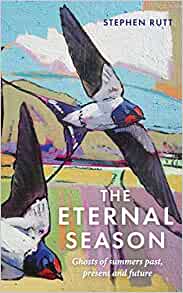
It wouldn’t be fair to single one out, but I’ve recently particularly enjoyed reading a proof of Steve Rutt’s The Eternal Season, which is out in July. Does Josie George’s A Still Life count as ‘nature writing’? It’s a beautiful and honest memoir, and while there’s so much more to it, her observations on nature are imbued with intelligence and perception. Also, Richard Smyth’s An Indifference of Birds – a very short and fascinating look at how we’ve changed the world for birds.
What author(s) do you buy their books without even reading the blurb?
I actually very rarely read blurbs, especially for fiction – the result of a painful experience some years ago when the back cover blurb gave away (or hinted very strongly at) a plot twist that occurred on page 298 of a 330-page book. But I do rely strongly on the recommendations of people I trust. And when Unbound announced the crowdfunding of a new Douglas Adams book – a neat trick for someone who’s been dead for twenty years, and one of which he would no doubt have approved – you couldn’t see me for the clicking.
What are you currently reading and would you recommend it?
Two very contrasting books: Kurt Vonnegut’s Slaughterhouse-Five and Richard Fortey’s Fossils, both of which get a strong thumbs-up. I’ve also just finished Eley Williams’s A Liar’s Dictionary and John le Carré’s Tinker Tailor Soldier Spy – again, they gave me enormous amounts of pleasure in different ways.
Can you tell me some more information about your forthcoming book, Light Rains Sometimes Fall?
With great pleasure! It’s the story of a year spent looking at the nature on my local urban patch in south London. I took inspiration from the traditional Japanese calendar, which divides the year into 72 very short microseasons – about five days each. It occurred to me that this was an excellent way of noticing and charting the small changes in the natural world through the year, as well as an incentive to really pay attention to my local patch. It comes out on 16th September.
Thank you to Lev for answering the questions I posed really quickly. I can recommend following his Twitter and signing up for his newsletter as his deadpan humour is hilarious.

Much Ado About Mothing by James Lowen

4.5 out of 5 stars

A copy of this was provided free of charge from the publisher in return for an honest review.

Compared to the dazzling colours of butterflies, I have always thought of moths as drab, slightly uninteresting insects that you only came across around the bathroom light just as I was getting ready for bed. I had been fortunate to see the odd hawk moth too. One was resting high on a wall at the shops near me a couple of years ago and I was amazed by how big it was. Apart from that, I knew next to nothing about moths.

James Lowen was the same until a particular date, 7th July 2012. He describes it as the day that changed his life forever. Until then he had considered moths as small brown and dull, uninteresting and even slightly eerie. Occasionally he even hated them. But what he had just seen had thrown him completely, it was a Poplar Hawk-moth, and she was utterly beautiful, he had been hit by what they call in Sicily, the thunderbolt. He was now smitten.

This interest grew and grew until he reached a point where he wanted to undertake some sort of a quest over the course of a year. Similar to those that have been all around the country looking for butterflies, orchids and dragonflies. Whilst those can be a challenge, there are relatively few species of those, whereas with moths there are around 2500 different species, and from what he could see from the guide books a sizable proportion of them looked remarkably similar. Especially the micro-moths! Instead, he decided that he would try and find the scarce and rare moths from various places around the country and tell their stories.

Searching for these moths would involve many very late nights, these are night insects after all, and he would drive around 14,000 miles in total travelling from the wilds of northern Scotland to the balmy Iles of Scilly and lots of places in between. Some of the moths he is hoping to find have been seen by almost nobody and a number of them are really local, moving no more than a handful of meters from where they hatched. He will find them in Second World War bunkers, near Neolithic mines, on heathlands and in the middle of forests.

Some of the names of these moths are fantastic. For example the Hummingbird hawk moth or the Bedstraw Hawk-moth but there are the Silver Barred, the Marsh Carpet, Rosy Footman, Jersey Tiger and the Pearly Underwing. Not all of them have these fantastic names though a number of them just have their Latin names and you need to be an expert to determine which is which.

I thought that this was a really enjoyable read. I like his writing style too, he includes enough detail in the prose to demonstrate that he knows what he is talking about, but doesn’t make it so complicated that it reads like a series of academic papers. He knows that the reader may know almost nothing about the subject so he writes with gleeful enthusiasm and a passion bordering on obsession about his mothy subjects. He says that he isn’t obsessed with these amazing insects, but I think he is besotted. I really enjoyed reading it and it makes me want to go out and get a moth trap now.

May 2021 Review

May seemed to rush past. I didn’t get quite as much reading down as I wanted as I spent an inordinate amount of it up a ladder decorating. But we are nearly done now in the hall stairs and landing now so I can get fully back to the books. I still managed to get around to reading 16 books in May and here is a roundup of them:

I read three books that had mental health as the central focus. In Finding True North, Linda Gask tells of her move to Orkney and coming to terms with a lifetime of depression and the lessons that she learnt by helping others overcome their issues. Moving to a smallholding was supposed to be the ultimate dream for Rebecca Schiller, however, as she tells us in Earthed things didn’t go quite as planned until the medical profession finally diagnosed her condition. Phosphorescence is very different. Julia Baird has long been fascinated by the natural light that is given off by creatures and she sees that as a metaphor that we can use to inspire us to do better and greater things.


My three poetry books this month could not have been any different. One was my first Seamus Heaney and whilst I didn’t love it, I did really like the way that he crafts words into these poems about the rural culture he is steeped in. Very different is watery through the gaps, rather than the connection via the land, Emma Blas is looking for a connection via water in her prose. Different once again is Victoria Bennett’s pamphlet, To Start The Year From Its Quiet Centre which is about the loss of her mother. Very moving poems.


Just two natural history books this month, one of which is my book of the month at the bottom of this post. First though is Empire of Ants which is about those amazing little creatures that have been creating societies for millions of years and the research that Suzanne Foitzik has been undertaking on them. A very interesting book,

Not quite natural history, but still very much well worth reading is Helen Gordon’s new book, Notes from Deep Time. this is a deep-time view of the forces that create and still have the power to change our planet.

Where possible I am trying to read themed books together. This month the theme was technology and I have five different books on how were are using and coping with technology in the modern world. Fred Vogelstein’s book is a bit like ancient history now as it looks into the rivalry between Apple and Google. It was an interesting read though. My now teenage kids have grown up with broadband and online access. They have never had to suffer dial up! Born Digital is a look at how this new generation is coping with the always online permanent connection to the worldwide web. Really well done and worth reading. Tracey Follows comes at this from a different angle and looks at the things we need to do and have in place to maintain a strong and balanced online presence.


Everybody Lies is about the data that we generate every time we do something online and how looking at this metadata can show trends before they are visible in the real world. More worrying are the revelations revealed in Reset, this is how the surveillance industry tracks what we are doing and how less than honourable companies are turning that to their advantage.


My two travel book could not have been any more different this month. Westering is the account of Laurence Mitchell’s walk from Norfolk to Wales. Paul Theroux’s book is about the time that he spent in Mexico finding out more about the country that borders his and the pressures that people are under to move to America to eke out a living.


My book of the mo(n)th is Much Ado About Mothing. Moths are one of those insects that have bad press but in this book, by James Lowen aims to set the record straight. He is a teenie bit obsessed by moths and he does a really good job of conveying that in the prose.


Have you read any of these? Are there any that you now want to? Let me know in the comments below
Earthed by Rebecca Schiller

4 out of 5 stars

A copy of this was provided free of charge from the publisher in return for an honest review.

Lots of people have dreamt of moving away from the city and taking over a smallholding to grow their own food and keep a few chickens and live out their version of the good life. I have occasionally considered it myself too. But it is hard work, plants do not grow with a few minutes of care each day, you need to graft to get the bountiful harvests that you see others producing.

Rebecca Schiller turned her fantasy into a reality back in 2017 when they moved to a smallholding. The stark reality of that dream became evident after a while when the list of things to do each and every day grew to monstrous proportions and with it an overwhelming sense of not being able to cope with any of the challenges that life was throwing at her.

Over breakfast something small finally tips me off that ledge – the one that I have been balancing on for quite some time.

This is the story of her life on that small plot of land and is an open and occasionally a brutally honest account of her suffering from all manner of mental health issues whilst trying to hold together a smallholding, her marriage and her family. Her mental health is something that she struggles with to a greater or lesser extent throughout the book, whether it is dealing with the mini family crisis that crops up with children or just facing the endless daily tasks. There are moments of happiness, small things that raise a smile like the first fruits or fresh eggs and the warmth of a summer day.

I need this smallholding to be a simple, easy, happy family affair with a greenhouse that has all its panes. But it is not and this kind of life has never been like that and never will be. The phrase ‘simple life’ wasn’t coined by anyone who tried to live it

Even though the subject matter might not be for everyone I thought that this was well written. I am sure we only get a flavour of her suffering and the pain that she was causing to her husband, Jared whilst she was ill. I liked the dash of history of her plot of land that is a part of the book, it helps to earth her and is a reminder that we are merely custodians of this planet. I wasn’t sure about the fictional elements as she imagined the women who once worked the land to feed their families. Even though it could be quite bleak at times, there is a positive message here too, partly that modern medical treatments can and do work when the professionals know what is wrong, but also that a connection to a landscape can keep you rooted.

On The Plain Of Snakes by Paul Theroux

4 out of 5 stars

The image that Mexico wants to portray of their country is very different to the reality that exists. It is a country that is in the grip of drug gangs who commit all sorts of murders and atrocities with little or no enforcement from the police and army; in fact, in a lot of cases, the police are another arm of the gangs. Given the violence that permeates the country and the border region in particular, there are 30,00 murders a year there, it is probably not the most sensible place to travel, but that has never stopped Paul Theroux.

He begins his journey in the town of Nogales a town of two halves. It is split by a 40-foot high steel fence that separates the United States of America from Mexico and is a microcosm of each country. The US side is prosperous and the Mexican side, run down and impoverished. It fills with people either hoping to make the crossing from south to north or who have been returned from America and have nowhere else to go now.

‘What is the meaning of Coixlahuaca?’
‘El llana de las serpientes.’
The plain of snakes.

He is not there as a tourist though, he wants to try and understand what is the pull of his country to these people and gain an insight into why they risk so much in the hands of coyotes while walking through the deserts of Arizona. To do this, he wants to meet the real people of the border towns, sometimes by taking his American plated car which has its own set of risks as he finds out when he is stopped by an overzealous policeman. He realises that this is not always the most sensible thing to do and often parks it in a secure place and takes the bus instead.

It seems that ever since the border at Reynosa, 1400 miles away, I had been travelling on a royal road through a plain of snakes.

He teaches a writing course for a short while and makes friends with those learning from him. In Oaxaca he becomes a student once again, this time learning Mexican Spanish alongside residents of the town who still maintain their independence from the rest of the country. It feels like a place he could live in. Travelling further into Mexico, he stops in the city of San Cristóbal de las Casas where he meets Zapatistas who are trying to force political change in the region.

One of the greatest thrills in travel is to know the satisfaction of arrival and to find oneself among friends.

I have a lot of Paul Theroux’s books (including a signed one) but as yet haven’t read that many of them for a variety of reasons, the top one being that I have so many other books… So far I have read two, this and Deep South. In that book, he was travelling around the southern states of America to try to understand the people of that region in his own country. In here he has popped over the border to discover more about the country that has been the subject of quite a lot of vindictiveness from the previous administration in the White House, Mexico.

Theroux is prepared to meet the locals in the way that suits him best by spending time in their towns and mixing with them. He is a sensitive and perceptive traveller and this comes across in this book as he describes the towns, people and food he experiences each day her is there. He does not seek to judge them, it is a troubled country, that is suffering from gang violence as well as being fundamentally corrupt. Most of the population are just trying to live to support their families, even if that means earning money in America for a portion of their lives.

« Older posts Newer posts »

© 2026 Halfman, Halfbook

Theme by Anders NorénUp ↑