I’m not sure if you have heard of the author Melissa Harrison, but she has written the haunting beautiful books, In Hawthorn Time and Clay as well as the new non fiction natural history Rain. She is well worth reading, and here is a little interview i did with her.
Page 186 of 188
The longlist for the Wainwright Prize has just been released:
Being a Beast by Charles Foster (Profile Books)
Coastlines: The Story of Our Shore by Patrick Barkham (Granta)
Common Ground by Rob Cowen (Penguin Random House)
Landmarks by Robert Macfarlane (Penguin Random House)
Landskipping by Anna Pavord (Bloomsbury)
Rain by Melissa Harrison (Faber & Faber)
Raptor: A Journey Through Birds by James Macdonald Lockhart (HarperCollins)
The Fish Ladder by Katharine Norbury (Bloomsbury)
The Moth Snowstorm by Michael McCarthy (John Murray)
The Outrun by Amy Liptrot (Canongate)
The Shepherd’s Life by James Rebanks (Penguin Random House)
Weatherland: Writers & Artists Under English Skies by Alexandra Harris (Thames & Hudson
Have read 11 of them so far!
 The Fish Ladder: A Journey Upstream by Katharine Norbury
My rating: 3 of 5 stars
Norbury has always been missing something from her past. She had been abandoned as a baby in a convent just outside Liverpool and had been adopted into a loving family. She had never been able to settle completely wandering and moving around the globe. Whilst living in Spain she miscarried, losing a long hoped for sibling for her eldest daughter Evie. Grief for the loss the child and of what might have been turned into an introspective look at herself, and the germination of an idea to follow a river from mouth to source. Moving back to the UK meant that she was closer to family and could start to develop this idea fully. Hoping that the walk will distract her from the grief, a life changing event means that she has to try to find her birth mother who she hopes will have some of the answers to her questions.
Norbury has drawn inspiration from several genres to write this book. Weaving travel, natural history, poetry and mythology it is also a very personal memoir. It is quite an emotive read too, with the highs and lows of family and life laid bare. The writing is poetic, lyrical and at times dreamlike and ethereal, almost with a imagined quality. Her writing is when she is describing the natural world and landscape is very evocative too; you could be standing alongside her. Painful to read at times, you live with her trials and tribulations, but she is tenacious in the face of everything. Enjoyable generally, but occasionally felt a touch fictional. Would definitely read more by her though. 3.5 stars.
 Last Tango in Buenos Aires: Sketches from the Argentine by David Marsh
My rating: 3 of 5 stars
When you ask people to think about Argentina; the most popular memories would be Maradona and the ‘hand of God’ and them invading the Falklands. Other things that might spring to mind are the Perons, the vast ranches raising the beef cattle for their spectacular barbeques and the stark beauty that is Patagonia. David marsh want to push past these stereotypes and discover the real people that live in this troubled country of contrasts.
On his journey he meets the real Argentinians; war veterans, gold diggers, teachers, priests and the indigenous Indian peoples. They tell him their stories, brining alive an Argentina that we know almost nothing about. There are tales of happier times when it was a rich and potentially key player in the world, to the tragedy of the families devastated by the military dictatorship that ‘disappeared’ so many innocent people.
It is not like a lot of travel books where it is a recollection of a series of observations; he meets all the people and draws the stories out, making this such an interesting book to read. Marsh has managed to convey a sense of the landscape too, as he travels from the cities to the high Andes and onto Patagonia. Well worth reading. 3.5 stars
Got a review copy of Hunter Killer: Inside the lethal world of drone warfare by T. Mark McCurley through the post today and these from the library:
Around the Coast in Eighty Waves by Jonathan Bennett
The Fish Ladder: A Journey Upstream by Katharine Norbury
Italian Ways: On and Off the Rails from Milan to Palermo by Tim Parks
Italian Ways: On and Off the Rails from Milan to Palermo by Tim Parks

 The Moth Snowstorm: Nature and Joy by Michael McCarthy
My rating: 4 of 5 stars
Being out and about in the countryside has lots of positives; the views, the fresh air, the sound of bird song and restores our deep connections with the natural world. In The Moth Snowstorm he argues that we cannot be fully human if we lose those connections; for McCarthy the greatest gift that nature gives him is joy. The connections that link us to the outdoors run far back in our DNA, surveys have demonstrated that people subconsciously prefer the open savannah landscapes above all others and that patients in hospital heal faster when they have a view of the natural world through a window. Using various examples, he provides evidence of the damage that we are causing to the animals and landscapes of this world in the pursuit of profit and control. He describes pointless civil engineering projects in the South China Sea, blocking mud flats from the sea and stopping millions of birds having a place to feed on their long migratory routes.
McCarthy takes time to describe those pivotal points that changed his life. These moments of joy are deftly woven with the pain that the family suffered when he was young when his mother was admitted to an asylum and as his father was away at sea a lot, they were moved to his uncle and aunts house. His brother was traumatised by it; Michael sought solace in bird watching to avoid thinking of the pain and the loss. The family were reunited, though the relationships were fragile and strained. It took years for him to understand his exact feelings properly.
It is a beautifully written book by an accomplished author. You are not left in any doubt by his fury at the destruction of habitats and places that creatures are totally dependent on them for survival. Whilst we still have some fantastic things left to see, he remind us of what we have lost. The title of the book is a recollection of the masses of moths that people remember driving through a few decades ago that were attracted to the headlights. The decline of some species has reached 90% and they are the lucky ones; others are no longer with us. He is critical of some of the attempts to reverse the trends, explaining why he thinks that they don’t go far enough.
Frankly it is a worrying book; if we mess this up we don’t have another planet. 4.5 stars
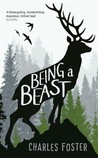 Being A Beast by Charles Foster
My rating: 3 of 5 stars
Have you ever wondered just what it would be like to be an eagle soaring on thermals or a stag surveying your territory? Some of us may have whilst walking in the countryside or over a contemplative drink, but Charles Foster wanted to know what it was like. Really, really wanted to know… So he chose five different animals; swift, deer, fox, otter and badger, and would try to live their lives as best he could.
He spent six weeks with his son living as a badger inside a hill in Wales in a sett that a friend of his with a JCB had excavated. His friend would leave meals for them to scavenge; but they went for it, eating earthworms and other things that the forest provided, trying to move around on all fours to get a badger’s eye view of the woods they were in. Trying to mimic what an otter does, meant that he spent quite a while splashing around in rivers failing to catch fish, and leaving his own spraints along the banks. Living as an urban fox was easier, sleeping rough in back gardens and scavenging for food in bins, but it did nearly get him arrested! He spends time deep in woods being a deer, imagining what it would be like to be tracked by hounds. Becoming a swift was possibly the hardest, as flying unaided has evaded humans., but he did have a go with a parachute to get a feel of the wind in his hair, and the flies in his teeth.
The human view of the world has some parallels to these creatures; we share the same senses; sight, smell, taste and sound, but their adaption has made them specialists in very particular ways, enhancing their senses so that they survive and thrive. This book is very different to the usual ones that you will read on wildlife. By making the effort to see things from the animal point of view, he has given us a very, very different perspective on the natural world. That and he is a little bit mad… But it works; drawing on neuroscience and psychology his efforts to emulate the lives of the five animals, give him an insight to their daily struggle for survival. There are some amusing moments, and there were parts that I found revolting; but it was refreshing to read something with a very different perspective to the usual natural history books. 3.5 stars overall.
 The Shepherd’s Life: A Tale of the Lake District by James Rebanks
My rating: 5 of 5 stars
When people think of the Lake District the first thing that comes to mind is the landscape; the majestic fells, the lakes and tarns nestled among the peaks and valleys and the harsh beauty of our National Park. It is a place that has inspired writers and artists for hundreds of years, and has 16 million visitors every year. However, for a number of people they are completely dependent on this landscape to make their living. James Rebanks is one of those people.
The Rebanks family have lived and worked as shepherds in the Lake District for generations. His father was a shepherd before him, and his grandfather taught both of them all he knew. The inexorable grind of the seasons defines what they do and when. The Herdwick flock is moved up onto the high fell during the summer, and all the farmers gather to bring it down at the end of the season. The shows and sales are in the autumn when they sell the spare lambs and look for the new males tups to add to their bloodlines and quality of stock. Winter is the hardest time; the incessant rain, heavy snows and storms make keeping the sheep alive a daily battle, even for the tough Herdwicks. Spring brings new challenges as it is lambing time. Most of his flock can manage perfectly well, but there is always those that can’t and need that extra assistance. As another year passes the sheep are move back up onto the fells once again.
‘This is my life. I want no other.’
Rebanks is not afraid of hard work. Following his father and grandfather into this way of life, and he has chosen a tough and demanding career, but he loves it. He paid little attention at school, wanting to be out in the fields and up on the fells, continuing a way of life that people from the Viking age would still recognise. In his early twenties started education again this time with the single mindedness and determination to succeed. It gave him a separate career that supports the work on the farm. Like his father, he is strong minded and opinionated; great qualities for battling through all that the elements and bureaucracy have to throw at him, but not necessarily for making relationships straightforward. He is not the most eloquent or lyrical of writers, he tells it as it is, but the enthusiasm for his way of life comes across is deep hearted and honest and this is what makes this book such a pleasure to read.
Went to a World book night event last night and managed to collect two new books:
The Hurley Maker’s Son by Patrick Deeley
The Running Hare: The secret life of farmland by John Lewis-Stempel
And was given one of the new Bard is my Bag Tote bags too.

Library Haul today:
Being a Beast: Adventures Across the Species Divide by Charles Foster
Rainbow Dust: Three Centuries of Delight in British Butterflies by Peter Marren
The Moth Snowstorm: Nature and Joy byMichael McCarthy
Fellside by M.R. Carey

And received a review copy of :
The Four-Dimensional Human: Ways of Being in the Digital World by Laurence Scott


Recent Comments