Category: Review (Page 32 of 133)

In Ethiopia With A Mule by Dervla Murphy

4 out of 5 stars

A copy of this was provided free of charge from the publisher in return for an honest review.

When asked why she wanted to visit Ethiopia, Murphy couldn’t exactly say why. It could have been the stories that she heard in her childhood of the Queen of Sheba and the history of the country named Abyssinia. It was a difficult country to explore and those that did make it there sent back reports of a mountain empire that told of its beauty, danger, solitude and mystery.

Her first glimpse of the country was from the boat she was arriving on and after she passed through the long process of immigration and customs she was ashore. She found somewhere to stay and drank five pints of talla, a light highland beer. After a nights sleep, she tried the staples of Ethiopia, injara and wat before taking a walk around the city. The plan was to walk across the highlands of Ethiopia, but walking uses a different set of muscles to cycling and carrying a heavy bag turns her feet into a bloody mess.

After a failed attempt, she was taken to a place where there were six mules to choose from. The one she picked was a docile animal who she could handle well. She called him Jock after a dependable friend. Learning how to load him was to be a steep learning curve and finding the correct equipment for Jock a few days after she departed would be a blessing. She was looking forward to this trip very much, but the locals were concerned that she would be attached by the shifta, the local criminals of the region.

It was blissful to be on my own again – alone in a region that looked more grandly wild and felt more utterly remote than anywhere else I have ever been.

Even though she was bored by geography when at school, she found her niche when travelling and this trip was just the sort of thing that she needed. There are good and bad days, reading about her robbery is unsettling as the punishment given out to her attackers is equally grim. She develops a strong affection for the highland people and their way of life and like to listen to the calls they make across the thin mountain air as she walks with Jock.

I liked this book a lot. Murphy is a stubborn traveller who will not be dictated to by anybody when she has made her mind up. This belligerence is not insensitivity to the people around her and that she meets on her walk with Jock across the highlands of Ethiopia, but it helps her overcome her internal fears about what she is doing. Her descriptions of the landscape are what makes this particular book for me, the harshness has its own beauty that she conveys really well.

Where The Indus Is Young by Dervla Murphy

4 out of 5 stars

She knew she wasn’t at home as the slightly ominous sign over the desk read ‘Visitors are requested to leave their weapons at the desk before entering the restaurant’… The man she spoke to in Pindi could not believe that she wanted to go to Baltistan, as he tells her, even Balti’s don’t want to spend the winter in Baltistan as it is so cold. She was not to be dissuaded and paid for the flights to Gilgit.

Following on from her successful trip to South India, Derval Murphy was keen to see more of the subcontinent with her daughter, Rachel. They chose to explore, “Little Tibet,” a place in the Karakoram Mountains, high up in the Himalayas. They finally arrive in Gilgit on the 19th December 1974 after surviving what was once one of the most dangerous flights in the world. On the way there she had pointed out some of the routes she had cycled a few years before; Rachel thought she was dotty. They start to get an idea of just how cold it is going to be as fresh snow often falls overnight.

There was enchantment there, in the brilliance and silence of that noon hour, with golden light pouring in from a dark blue mountain sky and the lake a steady mirror full of the beauty of glittering peaks.

On dawn on Christmas Day, the band plays Auld Land Syne for 30 minutes without a pause, and then 30 or so riders on ponies rushed past and disappeared into the foggy morning. They would be travelling high into the mountains on a packed jeep to the place where they would begin their trek. Soon after they arrived in the region, Murphy acquired a pony that they christened Hallam as she intended to walk and trek her chosen route. They would be off as soon as the blizzards relented.

Their route alongside the would take them from village to village, enjoying the hospitality of the locals and marvelling at the magnificent views, though Rachel did say that the landscape was untidy. Both she and her daughter are tough, they survive on meagre rations all the way on their trip, are quite often chilled to the bone as they traverse the passes and mountains. They find companionship and hardship in equal measure, and her six-year-old daughter takes all of it in her stride, she is a natural traveller like her mother.

Here, Hallam and I waited for Rachel – a tiny red figure toiling gallantly up the steep white slope, with frequent pauses to lean on my dula and regain breath, for the air was exhaustingly thin.

I liked this a lot. It is written in a diary format so even reading this today, it feels that you are with her every step of the way. Murphy manages to get across just how tough life is for the people of Baltistan, partly because of their location in the Himalayas and partly because of the way that the land has degraded over time. It seems fairly safe compared to some of her other trips where she has been robbed, but the landscape is another factor, there are some heart-stopping moments as they cross the remnants of an avalanche or teeter at the top of a narrow path with the river hundreds of feet below.

On A Shoestring to Coorg by Dervla Murphy

4 out of 5 stars

Sometimes the best trips are the ones with the sketchiest of outlines. So it was with Dervla Murphy who is accompanied by her five-year-old daughter, Rachel in their four-month travels in Coorg, in 1973/74. They had landed in Bombay but were there very little time as it was too busy and oppressive so they decide to take the slow route to the southernmost point of India, Cape Comorin.

One is a much less light-hearted traveller with a foal at foot.

Rather than move ever onwards, they decide that they like one region so much that they choose to return to it and spend more time there. In the end, they end up staying two months in Coorg settling into life there on their tiny budget. This longer time spent there gives Murphy the time that she needs to really understand the people around her.

She is a much braver person than me, I am not sure that I would have taken a five-year-old to India. That said, I think that her daughter Rachel really liked the trip even there were a few heart-stopping moments. To say that she has a relaxed parenting style is a bit of an understatement, she allows Rachel her own independence to choose those she wants to play with, leaving her home or with other people while she undertakes chores and shopping trips.

Every day I fall more seriously in love with Coorg; it is the only place outside of my only little corner of Ireland, where I could imagine myself happy to live permanently.

I have had a few hit and misses with Murphy’s books before, but I thought this was really good. The diary format works really well for this book as she recounts the events of the day that has just passed and the time spent in one place gives an insight that someone passing through would never see. She is a pragmatic traveller, wanting to experience the country and slowly but surely falls in love with Coorg and the people there. If you want a flavour of what India was like in the early 1970s this is as a good a book to read as any other.

Minarets in the Mountains by Tharik Hussain

4 out of 5 stars

Thanks to the rise of the political right-wing, Muslim Europe is being pushed as a threat to our way of life in Europe and the UK. But if you go back far enough, in corners of the continent, you will find that there are communities of Muslims who have been have been living peacefully alongside Christians, Jews and pagans for centuries. They are as much a part of our history as anyone else.

Wanting to discover more about these people, Tharik Hussain sets off with his wife and young daughters around the Western Balkans in search of the people there. As he travels from Bosnia & Herzegovina to Serbia and Kosovo, North Macedonia, Montenegro and Albania he finds is a thriving Muslim community. He visits the Mostar Bridge that was rebuilt after it was destroyed during the Croat–Bosniak War, prays in mosques that are older than the Sistine Chapel and talks to many different factions of Muslims from Sunni’s to dervishes.

Between him and his wife, they planned a route taking guidance from the route that the Ottoman traveller Evliya Celebi took across the Ottoman Empire in the 1600s.  It feels really up to date, too. There is a lot of history in here, a particular fascination of Hussain’s, but there is much more detail about the towns that they stay in and the people that they meet during their travels.

I liked this book about a part of Europe and its history that I knew almost nothing about. Hussain is an engaging writer who has an open mind with regard to the people that he meets on his journey in the region. The other thing that worked for me in this book is that he is travelling with his family which is a very different context compared to the usual travel books where you have a lone writer and their take on a place. Well worth reading if you want a very different perspective on the history of Europe.

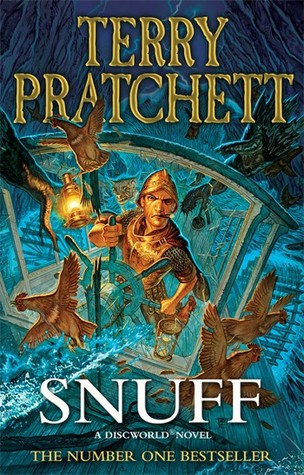
Snuff by Terry Pratchett

5 out of 5 stars

Against his better judgement, Vimes has been persuaded, no told, that he is go on holiday. He has even been asked to surrender his badge temporarily so he doesn’t think about work. The copper in him ran too deep, not even a brace of oxen would be able to pull that way of life from him. The envelope containing his bade is delivered to Lord Vetinari, but they all know that the badge isn’t in there…

Vimes had never been to the house, Crundells, but it was better known as Ramkin Hall. It was a pretty large estate, large enough to have a pub and a trout stream in the grounds. There would be staff too, lots of staff. This was something that Vimes was not used to given his background and pretty much every time he would make a fopa with his etiquette. He had managed to get it down to two weeks from a month away from work; his son was going to be there too and it was going to be interesting with his fascination with all things scatological…

It wasn’t long before he uncovers some foul goings-on and not long after that a murder. No one seems to be that bothered though as the poor victim is a goblin. However, Vimes senses that there is much more going on than just this one crime and poke about in the shadier parts of the countryside. The locals and especially the landed gentry are not particularly happy about this for a raft of reasons, so Vimes knows that he is obviously rattling the right cages.

Murder is one thing, but what he begins to uncover is an ancient crime far more terrible than murder.

The worst thing you can do is nothing.

I loved this. Pratchett has taken a good long hard look at our history and found a way of making it into a story that packs a strong moral punch. There is still the humour, I laughed out loud many times at the antics of the characters and never fail to be amazed at the way he can subtly include all manner of references to our history. Vimes is the star of this book though, in amongst all the titles and peerages is still that copper who can feel the street through his cardboard boots and has a sixth sense for truth.

100 Poets by John Carey

3 out of 5 stars

A copy of this was provided free of charge from the publisher in return for an honest review.

Poems seem such fleeting, transitory things. Yet these short verses of words that carry so much meaning have been with us since people have been able to write things down. The cross over between the spoken word, song and poetry has a long history too.

In this very personal collection by John Cary, he has selected the 100 poets that mean the most to him and he begins the collection with the words of Homer whose words were first written down by others over 2000 years ago. Sappho is his second selection who is thought to have lived from 630 – 570 bc but almost nothing is known of her.

There are the poets that I expected to find in here, Tennyson, Larkin, Plath and Hughes as well as finding that some people I had heard of, Edgar Allan Poe and D.H. Lawrence who had also written poetry.

I thought that this was a solid introduction to the 100 poets that are particular favourites of John Carey. There are of course some that I have heard of and even read before. But there are a large number that I had not come across before and a greater number of poets in here whose work I had bever read before.

I now have a list of others to read at some point soon. I did feel that it was missing contemporary poets who are writing today and creating classics that we will appreciate in years to come.

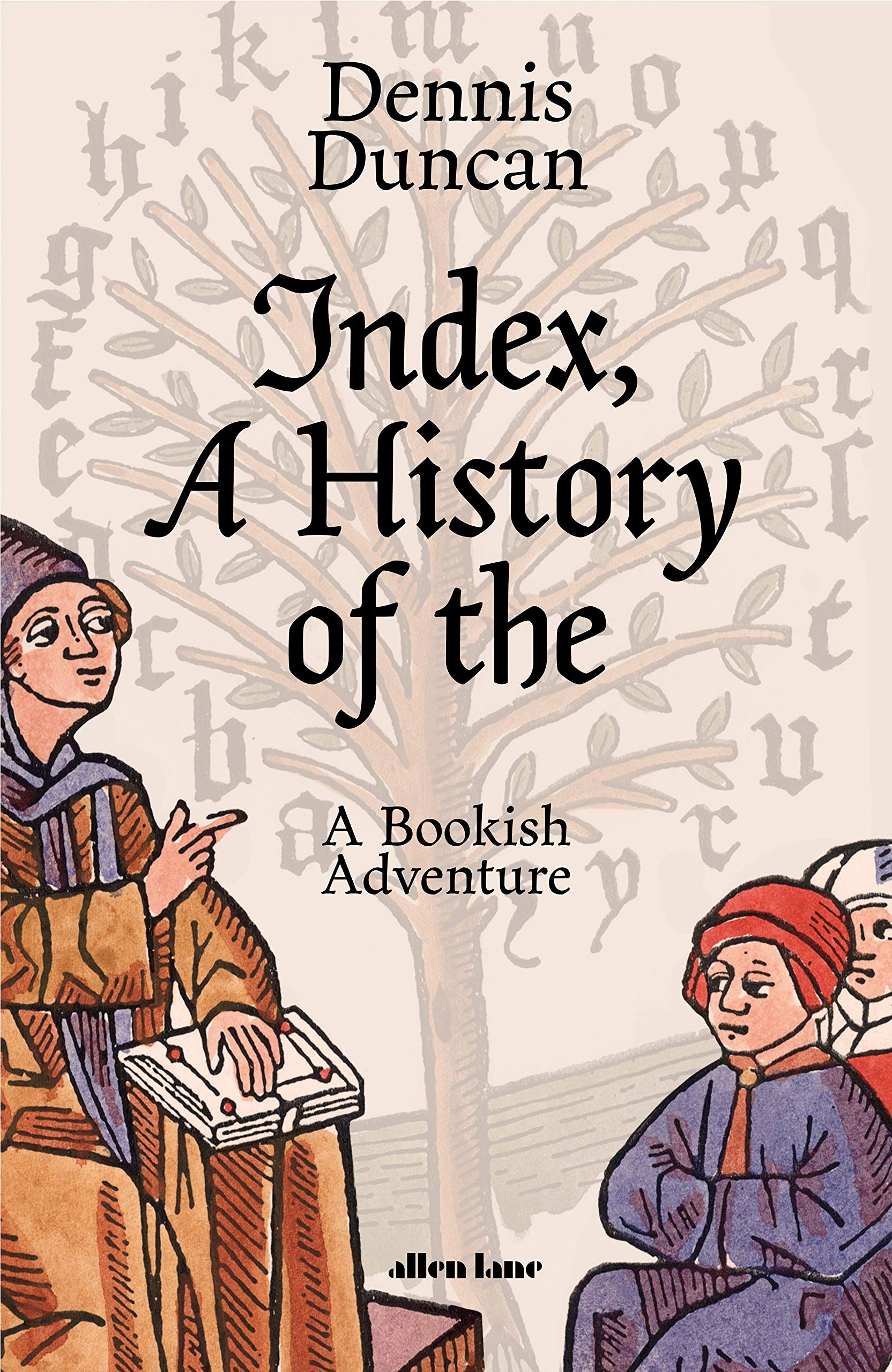
Index by Dennis Duncan

3 out of 5 stars

Ever had that moment when you remember reading something in a book and can’t remember what page it was on? I do frequently, especially when I am trying to find a quote for a review and when it is a fiction book I can sometimes not find what I am looking for at all. With non-fiction, I often stand a better chance as there is a tool I can use at the back of the book called the index.

It is the part of the book that people rarely venture too and I don’t always look at them, but there are points when trying to find a particular reference that is invaluable. But they need one other thing to work properly and that is page numbering. An index that can tell you what is in a book, but can’t tell you where to find it is not a lot of use…

He begins with just how we order things and the origins of the alphabet and how a man called Callimachus organised the 40,00 or so scrolls of Ptolemy II. Cicero the great Roman stateman also had an extensive library and he solved the problem of finding the scroll he needed by tags tied to the end of the scrolls. And it was these tags that gave us the word, index.

By the middle ages, the people that needed to find various references in books were the church and the codex, or the book format as we are familiar with nowadays had long been available. The two things that bring them together were the teaching and preaching of the age. Various religious men began to develop methods of finding scriptural references that they needed for sermons and the techniques caught on and were taken and developed by others.

The addition of page numbers would be a big help, but an index that referred to page numbers was not always accurate when dealing with handwritten books. A different scribe that had a larger script, could be producing a book that was several pages longer than the original. Ironically we have come full circle now as an e-reader can increase or decrease the font size making the page referencing nonsense…

He expands further on the way that these systems developed and ventures into the foolhardy attempts to try to index fiction. There is a section on searching the web, when you look for something on Google, you are not searching the web, rather you are looking at their index of pages and references that their bots have extracted, filtered and sorted.

It is not a bad book overall, but I did have the odd issue with it. I liked the way that he goes right back to find the very origins of the index and that the book is peppered with images from books and other sources as well as being crammed full of references and quotes. I liked that he had used a computer-generated index and a human-created index so you can see the differences between the two and make your own judgement about which s the best. This must be one of the few books with two indexes. However, I thought that the prose was a little dry and academic at times and thought that the narrative was not as strong as it could have been. Definitely one for the book geek.

Dear Reader by Cathy Rentzenbrink

3.5 out of 5 stars

A copy of this was provided free of charge from the publisher in return for an honest review.

Cathy Rentzenbrink has been a reader all of her life. As a child, she would lose herself in the stories and would read at every opportunity. This passion for books became a career too, she joined Waterstones as a bookseller and worked her way up to become a store manager before taking other opportunities in the publishing world.

Erwyn was in charge of reviewing the subs and came to find me. ‘Did you order sixteen copies of a reissue of Moon Tiger?’
‘Yes’, I squeaked. ‘It’s one of my favourite books of all time and it has an amazing new cover.’
‘Well, you’d better make sure they sell.’
Dear reader, I did

But this is more than a memoir of a bookseller seen through the pages of all the books she has read. Rather this is her life story so far and how through tragic events like the loss of her brother and the happier moments when she married and had her son, books and reading have been there to support her at every stage.

It always helped to know that others had walked through the fire and – though not undamaged – come out the other side.

This is a lovely book in lots of ways, even though she is dealing with the grief of losing her brother in the first part of the book all of her comfort is found between the pages of books. I liked that after every chapter in her life story she selects a small number of titles and tells us why she likes that particular book and the meaning that it holds for her still. I thought that it was nice to discover not only what books but also the reasons why.

The Spirit Engineer by A.J. West

3.5 out of 5 stars

A copy of this was provided free of charge from the publisher in return for an honest review.

In Belfast in 1914, there is an added interest in spiritualism again. More people than ever are attending seances again, with the hope of getting back in contact with loved ones who have since departed. William Crawford Jackson’s wife, Elizabeth, is one of those from high society who has a particular interest in this, hoping to get back into contact with her brother who was lost on the Titanic two years before.

He had discovered this by accident when he found a letter from the maid who has just left and he decides to follow Elizabeth to see where she is going. He sees her disappear into a house and notices a figure in the upstairs window looking down on him. It turns out that this is the famed medium, Kathleen Goligher. Jackson who is a Professor of Engineering is not particularly happy about this. He is very sceptical that it is real and dissuades Elizabeth from going to them again.

Money is tight in the house and his new textbook that the publisher thought would do well has sold poorly. He meets with a man at a party who persuades him to undertake some scientific research into mediums. His investigations become famous and he becomes known as the Spirit Engineer. However, will he prove one way or the other if these are genuine contacts with those now dead or just fraud…

I am not a great reader of Gothic melodramas, there is nothing wrong with them per se, it is just not my sort of thing, but I quite liked this. It is based on real events and people that West has used to create this story, adding to and embellishing the facts with a narrative that flows really well. The main character, William Crawford Jackson, is not particularly likeable, suffering as much from his own internal demons and vanity as he does from external pressure from society at that time. I don’t mind unlikeable characters in books as it makes for a more interesting story and it works in this book as the plot builds towards the end.

The Wheel by Jennifer Lane

4 out of 5 stars

A copy of this was provided free of charge from the publisher in return for an honest review.

Jennifer Lane had lots of opportunities ahead of her. She was an award-winning writer who had been published in many prestigious periodicals, but with this success came the many pressures of modern life. The relentless deadlines, long days and sometimes unbearable pressure. She thought she was coping, but one winter she reached a breaking point with the stress of everything.

She knew what she had to do though and that was to take charge of her destiny once again. The day was the 21st of December, I know it as the winter solstice but for a witch, this was Yule; the fire season. Her current life needed to go. Into the cauldron went the lists of things to do, notes for projects and other papers and she lit it. As they burnt, the white paper turning to black ash, a weight was lifted from her.

This was only the start though, she was going to rediscover the solace and purpose that witchcraft had given her as a teenager. She would follow the ritual from the Wheel of the Year that divides the regular calendar year into eight and is focused around the solstices and equinoxes. It is a system that seeks to find balance and harmony with the natural world and her body was yearning for it.

Her particular version of witchcraft is rooted in Wicca and she has adapted it to suit her particular needs, using Reiki and crystals at specific moments. Her journey was painful at times, as she moves away from the stresses and anxieties that nearly pushes her over the edge. But in here too, are moments of joy love, laughter and most of all healing as she rediscovers a path that she thought was once lost.

Lane is an engaging and thoughtful writer. She has a way of explaining the key elements of witchcraft that make it feel like a normal process that is as ancient as it is intrinsically linked to the world we inhabit. It doesn’t feel evil or weird occult practice. Her connection to this way of life has been rocky because of the pressures of modern life, but the journey that she takes us on around the wheel of the year shows how this works for her and gives her the tools to cope with the stresses of modern life.

« Older posts Newer posts »

© 2026 Halfman, Halfbook

Theme by Anders NorénUp ↑