Category: Review (Page 31 of 133)

River Kings by Cat Jarman

4 out of 5 stars

Most people who have had to do a smattering of history will have come across the Vikings and learnt about their antics. They were renowned sailors, fierce warriors and tyrants who raided and sacked many seaside towns and villages around the coast of the British Isles. The hoards that they left contained all manner of precious items that had come from all over Europe and even as far as India.

One of these precious items was a carnelian bead that came into her temporary possession just over a decade ago. Where this bead came from originally is the question that could not be answered without first asking many more questions about these people. Uncovering some of the answers to these is the subject of this book.

Dr Cat Jarman is very well placed to do this too, she works on the cutting edge of bioarchaeology, examining graves and artefacts and looking at the DNA of the men and women interred over 1000 years ago. Her story will reveal details of some of the people, where they came from, when they died and how they were related to other Vikings. I learnt how a fish-based diet can make remains seem much older than they actually are, that the chance find of runic graffiti in a church showed the presence of Vikings in the most unexpected of places.

There are stories in every place she looks, the mass graves and ship burials tell of a culture that was aggressive and highly developed. Evidence of Vikings moving through the rivers of Europe and dragging their boats overland to reach the middle east where they traded and raided in equal measure.

I really liked this, Jarman has done an excellent job of teasing out the stories from the science. The research is meticulous and she has got the mix of narrative and detail just about right. If you want a history book that makes you think again about the Vikings and the way that they changed the European continent, then this is a really good place to start.

Water Ways by Jasper Winn

4 out of 5 stars

A copy of this was provided free of charge from the publisher in return for an honest review.

Roads are now king. Almost everything is moved from port to warehouse, warehouse to store or most commonly now our home. Before the roads, rail was the most important way of moving people and goods around. You have to go back a long way to find the previous method of moving goods and raw materials around and that was water. It was loaded onto boats and moved along the coast or upstream as far as the river in question was navigable.

I thought the first canals to move bulk materials from place to place were cut in the 1700s, but it turns out that the first recognizable canal was made in the 1560s. This short stretch was to bypass a weir and was on the River Exe. It even had locks. For Winn, it seems to be the best place to start his exploration of the canal network, but he thinks getting a little experience on a boat would be useful. Thankfully being appointed writer in residence for the Canal and River Trust gives him plenty of contacts and he finds himself on the towpath on the Oxford Canal where he will be joining Kate Saffin for a short course narrow boating.

His travels will take him from coast to coast, through tunnels, and along towpaths on his foldable bike. He will speak to fishermen, discover why some people are now throwing magnets into the canals, spend time with a couple who provide fuels to narrowboat owners. He follows the people (nutters) who are tackling the Devizes to Westminster canoe race, joins in with the signing on a boat called the Village Butty and sinks quite a few pints with friends new and old. There is some history in here too, outlines of the brilliant engineers who designed and built the canals and the people in the 1950 and 1960s who couldn’t bear the thought of the network being filled in and worked tirelessly to save them.

I really liked this book, it brought back happy memories as I grew up very close to the Basingstoke Canal and loved cycling along the towpath. I have no recollection of ever falling in, but I am sure that I must have got the odd bootful of water occasionally. We are all supposed to be really close to a canal, but as far as I know there are no canals in Dorset. Winn has obviously fallen for the canal life too judging by this book. He writes with warm affection and a genuine interest for the places and people that he meets on his 1000 mile journey along the towpaths. I like the way he writes too, he has good attention to detail and shows how much these linear waterways mean to the people that use them for leisure, work and living. He has a light touch with humour and the maps on the endpapers are wonderful.

Extraction to Extinction by David Howe

3.5 out of 5 stars

A copy of this was provided free of charge from the publisher in return for an honest review.

Almost everything that we use or consume started in the crust of our planet in some way or other, even plants and trees are dependent on the soil. Unlike the other species that inhabit the Earth, we have learnt how to seek out and extract the materials that we can use in all manner of different ways. And we have been doing this for the past ten thousand years.

What we have achieved is just staggering too. We have extracted the metals from rock to make weapons, tools, buildings and vehicles. Rocks have been ground up to make a new substance that is the foundation of all our roads and construction industry. It reminded me of a quote from a Bill Bryson book that said: you could stand me on a beach till the end of time and never would it occur to me to try to make it into windows. We have gone from a species that had almost no impact on the places that we lived.

A lot of people have made a lot of money from these material extractions from our planet, but this wealth generation has come at a great cost to the planet. Vast mines have caused and continue to cause pollution and destruction to the places they are located. Processing these materials has been a contributing factor to the build-up of greenhouse gases too that will be a problem in the very near future. It begs the question, what are we going to do when we have used everything up?

I thought that this was a clear and concise explanation of how we have used ingenuity and skills to find numerous ways of extracting minerals and metals from the planet. We extract billions of tons of materials from the Earth each year, so much so that we are becoming our own geological time. He clearly explains the flip side to this is the rise in carbon dioxide that is contributing to climate change as well as the environmental catastrophe of vast commercial extractions to local areas. Howe’s prose is crisp and very much to the point making this a good introduction to the way that we extract and use minerals in modern life. But it is also a warning that what we are doing may not be repairable now. I thought it was well worth reading.

On Gallows Down by Nicola Chester

4 out of 5 stars

A copy of this was provided free of charge from the publisher in return for an honest review.

Nicola Chester was born in Petersfield but was always on the move because of her father’s job. Her earliest memories were of chalk downland, seen as they moved across Hampshire and into Berkshire before she moved to Pangbourne at the age of eight. It was here on this housing estate that she fell head over heels in love with nature> She was wild, free and happy in the fields alongside the houses, playing in the River Pang and water meadows.

But all my best memories, of love and family and living have been spent outdoors in nature. How can we stop fighting for this?

Another move to Greenham felt like a body part was being removed, but she soon felt at home in the natural world again as she discovered what was new around there. But it was also a realisation that not everywhere was accessible. This once common ground had been seized for the use of the RAF and it became the home of the American Nuclear force. It was also the home of the peace camp full of women protesting about the presence of these weapons of mass destruction. In the same way, she became aware of the natural world, Chester realised that land and who owned it and was granted access was a political issue.

It was an eye opening moment.

It is the natural world that is her bedrock and that enables her to cope with all that life throws at her and that she writes about in this book. We hear about the tragedies and the moments of joy, but not in a way that is overwhelming as a reader. She gets angry about the way that the landowners treat wildlife on their property and their disregard for life as they drench it in chemicals. But there are stories of hope and success too, Greenham Common can now be accessed by anyone again and it is buzzing with life around the brutal missile hangers. In this narrative, she weaves the history of the place as seen through other writers such as Richard Adam and John Clare.

A landscape doesn’t forget its stories. It wears them like lines on an old face, markings on an old body.

This is a searingly honest and open memoir of her and her families life set in the chalk downs of Wiltshire and I really liked it. Chester is a beautiful writer, she has a knack of describing what she sees in the most evocative way. But at its heart, this book is political; it is a critique of the still existing feudal system, tied houses and oppressive landowners that still dominate our country and ride roughshod over our rights and the natural world and a reminder that we need to stand up against these vested interests.

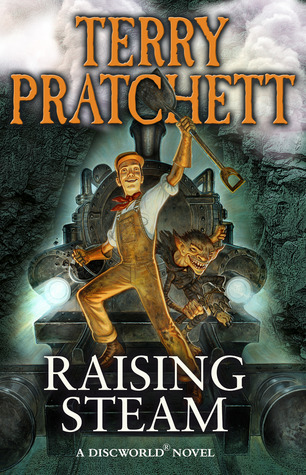
Raising Steam by Terry Pratchett

5 out of 5 stars

Dick Simnel is an engineer of some talent and with the help of his slide rule, he has developed the Discworld’s first steam locomotive, a machine that has somehow harnessed the power of all of the elements: earth, air, fire and water. It is called the Iron Girder. No one is really sure what to make of it, but when he brings it to Ankh-Morpork it piques the interest of Sir Harry King, a businessman who has made his money from the unsavoury business of waste.

Lord Vetinari, The Patrician of Ankh-Morpork, is also very interested in this device and he asks, well demands, that Moist von Lipwig, the renowned fraudster and civil servant to be his representative and the inside man inside this new industry. He is going to have his work cut out dealing with the great and the good as he persuades them to let the new railway lines over their land, but he has a deep and dodgy skill set to draw upon…

Not everyone is happy with the new railways though, some railway workers have been attacked and killed by Dwarfish fundamentalists and their terrorist attacks are getting worse. The Low King of the Dwarves is away at Quirm when there is a coup at the palace in Schmaltzberg, Überwald. Vetinari demands that the Low King is returned home to ensure political stability in the region, but even though Moist points out that the line is not complete, he is given no option to fail.

It is going to be a difficult journey, as not only are they somehow going to have to make it to Schmaltzberg, Überwald with the Low King on board, but they know they will be under attack from the rebel dwarves at some point and how they are going to get across the bridge is an audacious stunt that only Moist can pull off.

Another magnificent book from Pratchett, though you can sense cracks at the edge of the plot as the Embuggerance’s cold black fingers creep across his mind. He has purloined the plot from events in the UK when we went railway mad in the 18th century and draped it onto Discworld, where that places uneven lumps and bumps have shaped the story in his own unique way. There are lots of laugh out loud moments, as well as his own unique perspective on real-life that he sees through the prism of Discworld. Great stuff and one more to go…

Rag And Bone by Lisa Woollett

4 out of 5 stars

Think about the last thing that you threw into a bin. Was it waste that you couldn’t recycle, or was it something that someone could have taken and used again or in another way? If it is destined for landfill then there is a high chance that if it ever comes to life again if is going to be in as good a condition as when it was buried out of sight in a vast hole in the earth.

Gone are the days where almost everything was reused or repurposed leaving almost nothing to actually be discarded. Materials such as dog poo had a value, though I don’t fancy wearing the high-value calfskin gloves that it was used to make. Even a dead cat had value, provided you knew who needed them. It sounded like a grim life collecting these sorts of things.

Lisa Woollett is a mudlark and beachcomber when she is not taking photographs of things. This desire to find the items that others have discarded is deeply embedded in her DNA. Her grandfather collected waste and rubbish in London. Not only did they collect the rubbish from people, but they could also make a reasonable living acquiring the ‘toot’ or items salvaged from the rubbish that they could sell on.

She is based in Cornwall now and we are introduced to beaches there that seem to have a knack of collecting the items that fall of container chip on a regular basis. We also join her in London to find treasures alongside the Thames before heading out to the estuary to the landfill sites that are now being breached by rising tides and stronger storms. Rubbish from 1986 that has not deteriorated in all those years, falls out of the cliffs in front of them. The names of the places she visits are quite eerie too, Slaughterhouse Point, The Shade and Deadman’s Island, to name a few.

But it is a warning too, the waste that we are casually discarding is having a huge effect on the health of the oceans and the life in the depths. It is probably too late to fix it too, but some people are trying to make a difference. I particularly liked the photos that she has of the detritus from the various locations and collated as almost art. It is still shocking though.

Even though this is a book about rubbish, it is not a rubbish book and I really liked this. It is full of fascinating nuggets of information about the things that we have discarded and into this Lisa has woven her family history into this memoir seamlessly. If you liked Lara Maiklem’s book, Mudlark then you should read this too.

Folk Magic and Healing by Fez Inkwright

3.5 out of 5 stars

A copy of this was provided free of charge from the publisher in return for an honest review.

I remember reading a meme once that said that we need water and sunlight and are in essence just a houseplant with complicated emotions. But we need plants for all manner of things, food, shelter, clothing and if you know what you are doing then can be used to heal too.

Knowing what plant can be used for what particular ailment requires years of specialist knowledge and sadly it is something that most of us have lost as we moved from the country to towns. Thankfully is not totally lost as a select few people have managed to keep the country wisdom and are now beginning to share it with us.

Whilst not as comprehensive as the 900-page behemoth, Vickery’s Folk Flora by Roy Vickery, this is a beautifully produced book. The images and layout are really nicely done and there is enough information to give you an introduction to the medicinal treatments that we have used plants for and the folklore behind some of our common species. The A to Z format means that plants can be found quickly and the prose is full of useful information.

London Incognita by Gary Budden

5 out of 5 stars

There are a lot of people living in the capital, at the last count 8 million; it is dynamic, restless and constantly changing. However, not everything is gloss and glamour. Parts of the capital don’t even feel safe any time of the day, the seedier areas can creep out the bravest souls and things that have been thought long dead, still can be found if you know where to look.

Walking was the only way to map the streets of London Incognita

Danny has been searching for the stories of London Incognita, collecting them, writing them down in a cheap journal and hoping that what he gleans will help him define his own identity. But one of those presences is aware of what he is doing, the Judderman. The first Gary, Danny’s brother knows about all of this is when Danny disappears and as he walks the streets looking for him, he realises that it is something that he may not be able to escape from either

I was no longer an outsider; instead I was part of a club I never wished to be a member of.

Some of the stories feel dreamlike, so take us into the sewers, disused railway arches a spriggan leering face is visible among the graffiti. The mudlarks hold some of the keys to the darker snapshots of London’s history and finding the flickering woman may offer a route to the place where no shadows fall…

I went into this completely blind, I hadn’t even read the blurb before. It took me a short while to realise that these are a collection of short stories that have common links, characters and themes. The thing that ties that all together into a cohesive, slightly chilling whole. It is like Neverwhere taken up another notch before they get to London below. Budden has got the balance about right, there is enough detail about the grimmer darker, seedier parts of the capital without it becoming too much and the folk horror elements reveal enough to let my imagination run wild. My favourites were Sky City and My Queen, but they were all very good indeed.

Wheels Within Wheels by Dervla Murphy

3.5 out of 5 stars

The person that we become is often determined in our formative years. Dervla Murphy is one of those that would probably not be the tenacious person that she is today if she had a different upbringing. She was born ninety years ago in 1928 in Lismore, County Waterford, Ireland. She was an only child after her mother was advised not to have any more children because of rheumatoid arthritis.

Her mother’s health meant that she became an invalid very early on and she was looked after by her husband and daughter with some assistance from others at times. To get a break from the relentless pressure that caring for someone can have, she would take off for long rides around the local countryside from the age of eleven. She had been given her bicycle and an atlas at the age of ten and these two gifts gave her the idea of cycling to India after she realised that by just keeping pedalling she could make it to any point in the world she desired.

It was a tough life in that part of Ireland, but she was remarkable stoic given all the pressures and poverty she endured. She had a brief spell at a boarding school, but her mother insisted that it was only her that could look after her. She was to do this until her death in the early 1960s. She mostly complied with her requests, but there were moments when she fought back to give herself the space that she needed.

It is a fascinating read, though fairly uncomfortable at times as Murphy does not hold back as she unloads her feelings about the way that her mother treated her and used her as her nurse for so long. However, she is human enough to realise that they were not in a position as a family to be able to afford the care that she needed. It strengthened her character and ironically gave her the skills she need to travel the world as a lone woman on a bike.

A Place Apart by Dervla Murphy

3.5 out of 5 stars

A copy of this was provided free of charge from the publisher in return for an honest review.

As a seasoned world traveller, Dervla Murphy had been in lots of sticky situations in the past, she had been robbed, threatened and somehow emerged from the other side a slightly stronger person. One place that she had never been though, was Northern Ireland. So at the height of The Troubles, Dervla Murphy decided to cycle around Northern Ireland.

There were a number of reasons behind this; she wanted to understand the situation for herself by speaking to as many people from both sides of the divide as she could, then she wanted to make up her own mind about the trouble based on those conversations. Even though members of her family were connected to the IRA she had no loyalties, either way, just endless curiosity.

To say it was an eye-opening trip would be an understatement. She is genuinely moved by the things that she sees and the stories she hears. The ghettos in parts of Belfast are shocking as she never thought that she would ever see anything like that in Ireland. She hears stories of hatred on both sides that are absolutely chilling; human hate can be infinite in its suffering. She also finds out that cycling at night through Belfast is even more terrifying than travelling through a Himalayan valley. I cannot and do not want to imagine just how hard it must have been to live there at that time

There are moments in here that showed that people were starting to push back against the violence. The peace walks were beginning to happen, people from across the divide were starting to talk in private and there was a deep desire in the separate communities for the killings to stop. She spends time in the bars and the pubs sinking pints with men mostly and trying to understand why some of these people did what they did. Most eye-opening is her visit to see Ian Paisley and her scathing opinion of him.

It is difficult to like elements of this book; Murphy writes about Northern Ireland at one of its worst moments in history and the pointless and unnecessary death and suffering that both sides caused. It has dated and that is a good thing as a lot of the partisan suffering has passed. This book is a good as historical reference of that time and is the phrase, the past is a foreign country, is perfectly apt for this book. I just hope that the present situation caused by Brexit can be resolved as the people there fully deserve to be able to live their lives.

« Older posts Newer posts »

© 2026 Halfman, Halfbook

Theme by Anders NorénUp ↑