Page 28 of 188

Eating to Extinction by Dan Saladino

5 out of 5 stars

When we had an allotment many many years ago we would spend ages pouring over the seed catalogues trying to find the tastiest fruit and vegetable to buy. Often the ones that came top of the plate taste test were the heritage ones. These are often ignored by supermarkets as they don’t meet their very stringent and specific requirements.

Seed companies also ignored them as the cost of registering them was prohibitive. So to get these seeds we had to sign up to an organisation whose members could see that losing them was a disaster in the making.

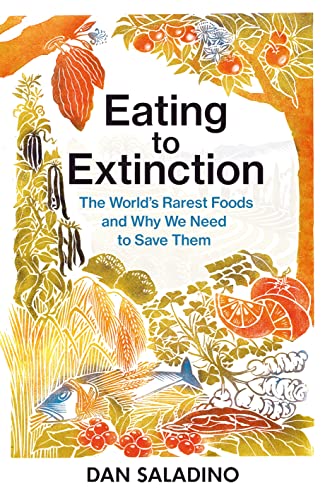
This disaster is now almost on us. But there are people all around the world fighting back now. In Eating to Extinction, Dan Saladino crisscrosses the planet to talk to the farmers, cooks and individuals who have a vested interest in making sure that these rare food and drink are being kept alive. We learn about the original varieties of corn in South America, Lambic beers in Belgium and indigenous communities who have gone back to the wild rice that is resistant to the diseases affecting modern varieties. It is a fascinating journey.

I thought that this was an excellent book about the looming disaster that the global food industry has the potential to become. I did notice that there are people at the top of these big businesses that dominate the global food system who are starting to make a noise. But vested interests still hold sway – at the moment. I have seen some reviews that complained that he goes into too much detail about the various food and drinks that he has investigated. But for me, this is exactly what we need, someone who is prepared to dig in and find the details of that particular grain or drink.

Reading it I felt like I was hearing his voice on the programmes that he presents on the Food Programme on BBC Radio 4. I liked the short essays on each subject too. It is a book that could be returned to again and again. Mostly though it is a call to arms to ensure that governments start to put in place the necessary regulations to ensure that we have more diversity in the food chain. Otherwise, we are all doomed…

Very highly recommended

February 2023 Review

Even though it is the shortest month, February always seems to drag. I have no idea why it feels that way. Didn’t quite reach my target of 16 books, but I am happy with 15, including three five star books this month! So here is what I read

Books Read

The Bookseller’s Tale – Martin Latham – 4.5 stars

Wahala – Nikki May – 3 stars

The Ship Asunder – Tom Nancollas – 3.5 stars

Dandelions – Thea Lenarduzzi – 3.5 stars

Pharmakon – Almudena Sánchez Tr. Katie Whittemore – 3.5 stars

The Quiet Moon – Kevin Parr – 4 stars

Sea Fever – Stuart Franklin – 3 stars

RSPB How to Photograph Garden Birds – Mark Carwardine – 3.5 stars

Making Cocoa for Kingsley Amis – Wendy Cope – 4 stars

Asian Waters – Humphrey Hawksley – 3.5 stars

Park Life – Tom Chesshyre – 3.5 stars

Walking With Nomads – Alice Morrison – 4 stars


Book(s) Of The Month

Eating to Extinction – Dan Saladino – 5 stars

This is a brilliant exploration of the global food system and the perilous state it is in because of our reliance on only a few species of Food. We need to start bringing more diversity into the food system as soon as possible.

Under The Blue – Oana Aristide – 5 stars

Even though this is about the catastrophic effects of a global pandemic, this is a brilliantly written story of three people who are trying to get to safety.

The Lost Orchards – Liz Copas & Nick Poole – 5 stars

I love books on orchards and this one about the discovery of the apple trees that were once thought lost is quite magical.


Top Genres

Normal service is starting to be resumed…

Natural History– 4

Fiction– 4

Poetry– 3

Science Fiction– 3

History– 3

Fantasy– 3

Photography– 2

Travel– 2

Politics– 1

Environmental– 1


Top Publishers

Faber & Faber– 3

Simon & Schuster– 3

Particular Books– 2

Little Toller– 2

William Heinemann– 1

Peepal Tree Press– 1

Basic Books– 1

Bardwell Press– 1

Serpent’s Tail– 1

William Collins– 1


Review Copies Received

Two Lights: Walking through Landscapes of Loss and Life– James Roberts

The Last Sunset in the West: Britain’s Vanishing West Coast Orcas– Natalie Sanders

More Numbers Every Day: How Data, Stats, and Figures Control Our Lives and How to Set Ourselves Free– Micael Dahlén & Helge Thorbjørnsen

Cry of the Wild: Tales of sea, woods and hill– Charles Foster

The Flaw in the Crystal: And Other Uncanny Stories by May Sinclair– Ed. Mike Ashley


Library Books Checked Out

Nightwalking: Four Journeys into Britain After Dark– John Lewis-Stempel

Cane, Corn & Gully– Safiya Kamaria Kinshasa

Manorism– Yomi Sode

Quiet– Victoria Adukwei Bulley

The Last Overland: Singapore to London: The Return Journey Of The Iconic Land Rover Expedition– Alex Bescoby

Wayfinding: The Art And Science Of How We Find And Lose Our Way– Michael Bond

The Catch– Fiona Sampson

Ravilious & Co: The Pattern Of Friendship– Andy Friend

The Road: A Story of Romans and Ways to the Past– Christopher Hadley

All My Wild Mothers: A Memoir Of Motherhood, Loss And An Apothecary Garden– Victoria Bennet

Waypoints: A Journey On Foot – Robert Martineau

Grounded: A Journey Into The Landscapes Of Our Ancestors– James Canton


Books Bought

The Meaning of Liff– Douglas Adams & John Lloyd

The Old Drift– Namwali Serpell

It’s Not About the Tapas: A Spanish Adventure on Two Wheels– Polly Evans

The London Nobody Knows– Geoffrey Fletcher

West with the Night– Beryl Markham

The Wild Flowers of Dorset– Stuart Roberts

Spanish Lessons: Beginning a New Life In Spain– Derek Lambert

A Short Philosophy of Birds– “Philippe J. Dubois & Élise Rousseau”

Write It All Down: How to Put Your Life on the Page– Cathy Rentzenbrink

Travelling Light: Journeys Among Special People and Places– Alastair Sawday

I Remember: Farming Memories of Lincolnshire– George L.A. Lunn

Back to Nature: How To Love Life – And Save It– Chris Packham & Megan McCubbin

Castles and Forts– Colin Pomeroy

Landscapes of Legend: The Secret Heart of Britain– John Matthews & Michael J. Stead

Two Degrees West– Nicholas Crane (Signed)


Any from this long list that you have read? Any that you now want to read? Let me know in the comments below (now they are working again)

March 2023 TBR

After the website falling over at the beginning of the week I am back online. Mostly… I am still not getting any emails through at the moment though. ANyway, a couple of day late, here is my TBR for March:


Still Reading

The Travel Writing Tribe: Journeys in Search of a Genre Tim Hannigan


Review Books

The House of Islam Ed Husain

The Wonderful Mr Willughby: The First True Ornithologist Tim Birkhead

Handbook of Mammals of Madagascar Hardcover Nick Garbutt

Swan: Portrait of a Majestic Bird, from Mythical Meanings to the Modern Day Dan Keel

RSPB Handbook of Garden Wildlife: 3rd edition Peter Holden & Geoffrey Abbott

Isles at the Edge of the Sea Jonny Muir

Notes from the Cévennes: Half a Lifetime in Provincial France Adam Thorpe

Polling UnPacked: The History, Uses and Abuses of Political Opinion Polls Mark Pack

On the Scent: Unlocking The Mysteries Of Smell – And How Losing It Can Change Our World Paola Totaro and Robert Wainwright

The Serpent Coiled in Naples Marius Kociejowski

Books Nomad Century: How to Survive the Climate Upheaval Gaia Vince

Two Lights: Walking through Landscapes of Loss and Life James Roberts

The Last Sunset in the West: Britain’s Vanishing West Coast Orcas Natalie Sanders

More Numbers Every Day: How Data, Stats, and Figures Control Our Lives and How to Set Ourselves Free Micael Dahlén & Helge Thorbjørnsen

Falling Away David Banning


Other Books

Nightwalking: Four Journeys into Britain After Dark John Lewis-Stempel

The Last Overland: Singapore to London: The Return Journey Of The Iconic Land Rover Expedition Alex Bescoby

Afropean: Notes From Black Europe Johny Pitts

In the Shadow of the Mountain: A Memoir of Courage Silvia Vasquez-Lavado

Another Gulmohar Tree Aamer Hussein

A Walk in the Park: The Life and Times of a People’s Institution Travis Elborough

Wanderers: A History of Women Walking Kerri Andrews


Photobooks

Extraordinary Clouds: Skies of the Unexpected from the Beautiful to the Bizarre Richard Hamblyn


Poetry

Manorism Yomi Sode

Quiet Victoria Adukwei Bulley

Cane, Corn & Gully Safiya Kamaria Kinshasa


Challenge Books

The Overstory Richard Powers

Bloom: From Food to Fuel, the Epic Story of How Algae Can Save Our World Ruth Kassinger


Quite a few to get through, but there are a number of really short books in that list. Any that you like the look of?

The Crow Folk by Mark Stay

4 out of 5 stars

Faye Bright is a bubbly 17-year-old who helps her dad in his pub in the sleepy village of Woodville deep in the Kent countryside. It is a time of many changes, as Britain is now at war with Germany, planes cross the sky and the whole community is on edge with war preparations. Her mother passed away when she was tiny and she only has fragments of memories of her. She is delighted when she finds a book that her mother left for her.

The book is a revelation to Faye. Not only is there a recipe for jam roly-poly but is it packed full of spells and runes and other magical incantations. She has always felt a little different to the other children in the village and finding this means that some of the questions might have been answered. But is also means that she has many other questions for her dad now.

She may never get to ask them though, something has woken a dark force in the village and the scarecrows that were dotted around the fields are now stalking the countryside. Faye is going to have to learn to use the abilities that she has inherited from her mother much sooner than she anticipated.

I really liked this it is kind of a Rivers of London meets A Month in the Country… Not only are we finding out about Faye and her friends in this village, but Stay has made it eerie and disquieting. I love the folk horror elements of this. They have a genuinely sinister edge and are not in your face but bubbling away in the ditches of the landscape, I am looking forward to the next two in the series and I am pleased to see there is a fourth coming soon.

The Consolation of Nature by Michael McCarthy, Peter Marren & Jeremy Mynott

4 out of 5 stars

It feels like it was much longer ago, but that memory of the first lockdown being imposed in March 2020 is still vivid. We had known nothing like it and probably won’t again either, I was still going to work, as I can’t do much from home. The world changed for a lot of us at that moment.

One of the things that I noticed on my daily walk down to the river was the silence — almost no cars, no planes, and very few people around. I could hear things that the din of modern life suppresses. I wasn’t the only one to notice this, the stimulation and comfort that nature could give sparked an interest in the wilder population that I hope does not diminish.

Three authors who between them have written a substantial number of natural history books were also stuck at home. They decided to keep a diary of their time spent in lockdown and this book is the combined diary of their sightings on their daily walks as well as sober observations on the numbers of people dying from the virus.

I liked this a lot, all three authors write sensitively about the impact on society that we have come to know that the virus had. But underlying that is the realisation that this could give us an opportunity to make a difference for the wild world that is around us every day. Worth reading in my opinion.

What Remains? by Rupert Callender

4 out of 5 stars

A copy of this was provided free of charge from the publisher in return for an honest review.

I always say that there are three things that are inevitable. Death, taxes and your computer crashing. Nowadays my computer rarely crashes and tory grandees seem to think that taxes don’t apply to them. However, none of us can avoid death, even those who have taken it upon themselves to rely on the pseudoscience of cryogenics.

Almost all of the funerals that take place in the UK are rooted in the rituals and habits of the Victorian era. And whilst this is fine for most people, it is not right for others. Robert Callender describes himself as the first punk undertaker. But rather than a leather-clad bloke with some suspicious piercings and a mohican, he is a ray of light in the stilted world of the British undertakers.

The funeral system that exists in this country is very much a one size fits all and Callander wants to show that there are many other ways of coming to terms with the loss of a loved one. He aims to de-mystify the fears around death and the way that we see it in society and help people discover their own grief for the person that they have lost. Each funeral is for that family and he will rarely say no to anything should a family request it.

Even though death walks these pages, it is not morbid in the slightest. There are a lot of dead bodies in here and there are some parts that may be uncomfortable reading for some, I won’t expand on them here though. I felt that I was being guided by someone who is very sensitive to people’s actual needs as they say goodbye. I thought that it was interesting that he wrote about those that are laying to rest family members that were not always liked and in certain instances detested. It is really sensitively written, too. He has a knack for being reassuring and quietly confident in what he is doing and most importantly why he is doing it.

We Saw It All Happen by Julian Bishop

3.5 out of 5 stars

A copy of this was provided free of charge from the publisher in return for an honest review.

As humans, we have been changing our planet for thousands of years. We have laid waste to beautiful parts of the world and since the industrial revolution have been accelerating this damage in so many ways. The debate about this is highly charged, not helped but an aggressive campaign by those that will probably lose the most if we move away from fossil fuels.

One of those who is furious about what we are doing to this planet that we live on is Julian Bishop. In this his debut poetry collection, he is seeking to raise ‘an army of stubborn weeds’ to push back against the apathy of the political class.


Never were so many bells silent at once:

A congregation of flowers at prayer

We prayed for the dying elsewhere


Split into three sections, A Taster, Mains and Afters, Bishop covers a wide range of subjects in his poems, from Poached Salmon about how these fish are affected by rising water temperatures to Eton Mess, a barbed poem about are self-entitled leaders. There are notes in the back of the book about the news stories that inspired a particular poem.

This is not the most cheerful collection, but I kind of expected that. But then I can imagine that people picking this up would be passionate about the environment, What is very clear though is Bishops underlying fury and it is evident in all of his poems. It is a snapshot of humanity’s cruelty to almost every living this on this planet. What does come across though is that he still feels there is a glimmer of hope in amongst all the doom and gloom.


Four Favourite Poems

Una Fodera Argento

Pangolin

Highlights Of Mining For Gold In Indonesia

Rush Hour

A Bloggers Reading Journey – Always Need More Books

Today Blogger telling us about her reading Journey is Claire from Always Need More Books.

She is a book lovin’ technical librarian who has loved reading all her life.  She has always read but it was when she discovered Bookstagram, her reading and book buying habits reached a new level!

She describes herself as pretty old school, rarely reading ebooks, and preferring an actual book any day of the week. She reads a wide mixture of books, and probably the only genre she doesn’t read much is sci-fi, preferring contemporary literature as opposed to the classics, and also reads young adult as some of the books out there are outstanding.

She runs a book club in her home town at the local pub (usually between 5-10 of us). It is a great way to discover some amazing authors and books.


What is your earliest reading memory?

I can remember my mum reading to me…I can’t remember clearly the books but I can remember feelings they invoked


What was your favourite childhood book?

I liked the Richard Scarry books


What book do you remember reading at school?

I remember choosing a book in the school library for the first time…Pollyanna.


What was the book that changed you?

I’m finding this question hard! I don’t think there are books that have changed me but certain books mean more to me because they were read st important moments of my life


Who was the author who helped you discover a whole new genre?

Probably J K Rowling. Harry Potter was a book I wouldn’t have thought to read as an adult and fantasy is certainly not a genre I would have chosen


What was the last book that you bought?

The Marriage Portrait by Maggie O’Farrell


What was the last book you reread?

Rachel’s Holiday by Marian Keyes


What was the last book you couldn’t finish?

I can’t remember! It’s very rare for me to not finish!


The book I am currently reading

Christmas on the Murder Express by Alexandra Benedict


Where do you read?

Bed, sofa, bath…anywhere really!


What books/genres do you turn to, to get out of a reading slump?

Probably some sort of chicklit


What was your last five-star read?

We All Want Impossible Things by Catherine Newman


How many books do you currently own?

Probably around 800 but I don’t know for sure


What is the oldest book on your bookshelves?

An edition of Little Women that belonged to an aunt, Probably dating around 1950


What book did you last buy based on the cover?

Tomorrow and Tomorrow and Tomorrow by Gabrielle Zevin


What book do you always recommend?

Depends on who I’m talking too! I love particularly authors so will usually recommend those. Authors like Marian Keyes, Elizabeth Strout, Beth O’Leary, Maggie O’Farrell


You can find Claire on her blog here, on Twitter, here and on Instagram here

The Wheel of The Year by Rebecca Beattie

4 out of 5 stars

A copy of this was provided free of charge from the publisher in return for an honest review.

As I have spent more time in the natural world I have found those moments when the world turns at the solstices and equinoxes a framework for my own life. For me, there was something about seeing the sunset at Knowlton on the midsummer solstice last year that felt timeless. These moments when the world pivots onto a different time, have affected and influenced many forms of religion and spirituality across the world and far back in time.

One of the old religions that has had a deep and long contact with the natural world is Wiccan. In this, the cycles use these four points in the year along with Imbolc, Beltane, Lammas and Samhain at the midpoints between the main points. In this book, Rebecca Beattie gives pointers and ideas for ritual moments to reconnect to the natural world and the seasons once again. As well as the ritual side, there are several practical suggestions on this to make and do.

I liked this book. It comes across as non-threatening too, these witches are more interested in the natural world mindfulness and self-care than corrupting the minds of others. It is a very personal guide to how they perform their rituals and seasonal tasks of each of the eight festivals throughout the year.

If you want to find your inner pagan or find a different spiritual way to connect to nature then this is a good book to start with. This is written in a straightforward and accessible way for those wanting an introduction to the Wiccan and pagan year and the associated festivals. It has some similarities to The Wheel by Jennifer Lane, and I would recommend reading that as well as this book.

The Peckham Experiment by Guy Ware

4 out of 5 stars

A copy of this was provided free of charge from the publisher in return for an honest review.

Set over the course of a day, Charlie is reliving the life that he and his identical twin brother had from their working-class background and their participation in the radical Peckham Experiment. They lost their parents in the Second World War in a bombing raid.

They emerged blinking from the war with a desire to take the communist upbringing they had had into the new era. Their ideals were shattered when the tower block they were instrumental in building collapsed in 1968 causing a number of fatalities. The estate was then demolished in the mid-1980s and JJ’s life unravelled, he was a broken man.

And now he is dead.

It is now the day before the funeral and Charlie is trying to write the eulogy for, JJ. As he works his way through a bottle of brandy and shuffles around the house he unearths fragmentary memories of their past as he gets steadily more drunk on the spirit.

There were lots of things that I liked about this book. To begin with, this is a really well-done internal monologue by the main character. Even though it reaches back to 1930, it feels like a very contemporary book too as it is set at the time of the 2017 general election and the forced societal destruction being engineered by the Tories. It taught me some things about what had happened in the 1960s to a tower block, called Ronan Point when it partially collapsed in 1968, and that The Peckham Experiment was a real thing that took place between 1926 and 1950 when people actually cared how parts of society could look after themselves. Well worth reading.

« Older posts Newer posts »

© 2026 Halfman, Halfbook

Theme by Anders Norén — Up ↑